




Today’s food consumers expect more from the products they buy. They want visually engaging treats, recognizable ingredients, clean-label positioning, and transparency they can trust. At the same time, retailers are raising the bar for product differentiation, ingredient standards, and consistency.
For food brands, that creates a difficult balancing act. A product needs to look exciting enough to stand out on shelf, perform consistently through manufacturing, and support the claims and positioning used in marketing.
If your brand is positioned around trust, transparency, innovation, and current food trends, your sprinkles should be too.
Sprinkles Are Small, But Brand Impact Is Big
Sprinkles may be a small percentage of a finished product, but their impact on consumer perception can be much larger. They are often one of the first elements shoppers notice when they see a cookie, frozen dessert, snack, cereal, or bakery product.
Color, shape, texture, distribution, and overall appearance can influence whether a product looks premium, playful, indulgent, seasonal, or on-trend.
For brand managers and product marketers in snacks, bakery, confectionery, and frozen categories, sprinkles can either:
- Visually differentiate your product on the shelf
- Create a stronger connection between packaging and the finished product
- Reinforce clean-label and natural product positioning
- Support seasonal, limited-time, or promotional launches
- Give consumers a more distinctive eating experience
- Help a new SKU stand apart from competing products
- Strengthen the visual identity of an established product line
- Support premium positioning when appearance and ingredient quality align
The opposite is also true. Faded colors, inconsistent shapes, excessive color bleed, poor adhesion, or unexpected ingredients can undermine an otherwise well-positioned product.
That is why sprinkles should not be treated as an afterthought during product development. They are part of the finished product experience.
FoodGrid’s sprinkle catalog is designed to help brands find decorative inclusions that align with product requirements, ingredient expectations, and market positioning.
See how FoodGrid helps brands innovate faster →
The Clean-Label vs. Aesthetic Tradeoff
One of the biggest challenges for product developers and brand teams is balancing clean-label positioning with the visual impact consumers expect.
A product can have a strong ingredient story and still need to look exciting. In categories such as cookies, cupcakes, frozen desserts, snack bars, and confectionery, appearance can be a major part of the product experience.
The challenge is finding natural or clean-label decorative ingredients that deliver the right combination of color, texture, shape, stability, and label compatibility.
Too often, brands assume that moving away from artificial colors means accepting compromises in appearance or performance. That can create unnecessary pressure on R&D teams during formulation.
Here’s where the biggest issues arise:
- Color fade or bleeding during baking, freezing, storage, or application
- Inconsistent color intensity from batch to batch
- Crumbly or waxy textures that reduce the desired eating experience
- Poor adhesion that causes decorative inclusions to fall away during processing or packaging
- Moisture sensitivity that can affect appearance and texture
- Shape inconsistency that makes the finished product look less uniform
- Labelin
Product Storytelling, Powered by Your Sprinkles
Category managers and brand teams in snacks, confections, bakery, and frozen foods are often responsible for more than selecting ingredients. They are expected to translate consumer trends into products that look compelling, meet ingredient expectations, and give retailers a reason to bring the product to shelf.
That makes decorative inclusions more strategic than they may appear.
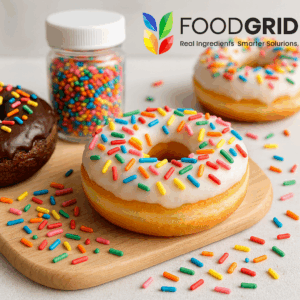
A sprinkle can help communicate a seasonal concept, reinforce a natural or plant-based positioning, or give an otherwise familiar product a visual point of difference. The right color and shape can also make a limited-time product feel new without requiring a completely different product platform.
FoodGrid supports product teams with sprinkle options designed around both consumer-facing appeal and product-development requirements, including:
- Limited-time seasonal colors for holiday, promotional, and seasonal launches
- On-trend shapes and inclusions that help products stand out visually
- Natural color options for brands moving away from artificial dyes
- Plant-based and vegan-friendly options for products targeting specific consumer preferences
- Non-GMO options for brands with corresponding ingredient requirements
- Allergen-conscious options for products with specific formulation needs
- Multiple colors and shapes for differentiated product concepts
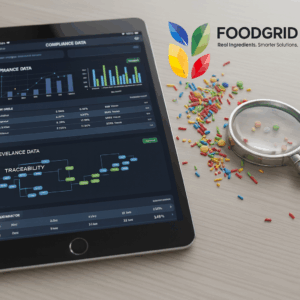
- Ingredient transparency and supporting documentation for internal review
- Commercially relevant formats for brands moving from concept development toward scale-up
This gives brand and product teams more flexibility when developing products around consumer trends.
For example, a seasonal cookie does not necessarily need a new base formulation to create excitement. A different sprinkle color, shape, or natural color combination can help establish a new visual identity while maintaining the core product platform.
The same approach can work across frozen desserts, snack bars, and cakes
Speed to Shelf = Brand Advantage
In food product development, timing can be just as important as the ingredient itself. A seasonal launch has a defined window. A retail reset has a deadline. A limited-time offer needs to reach the market while the trend is still relevant.
When ingredient sourcing becomes a bottleneck, the impact can extend far beyond procurement. Delayed samples can push back formulation. Formulation delays can affect sensory testing. Changes made late in development can create additional QA, regulatory, packaging, and production work.
That is why speed to shelf starts with having the right ingredient options available early.
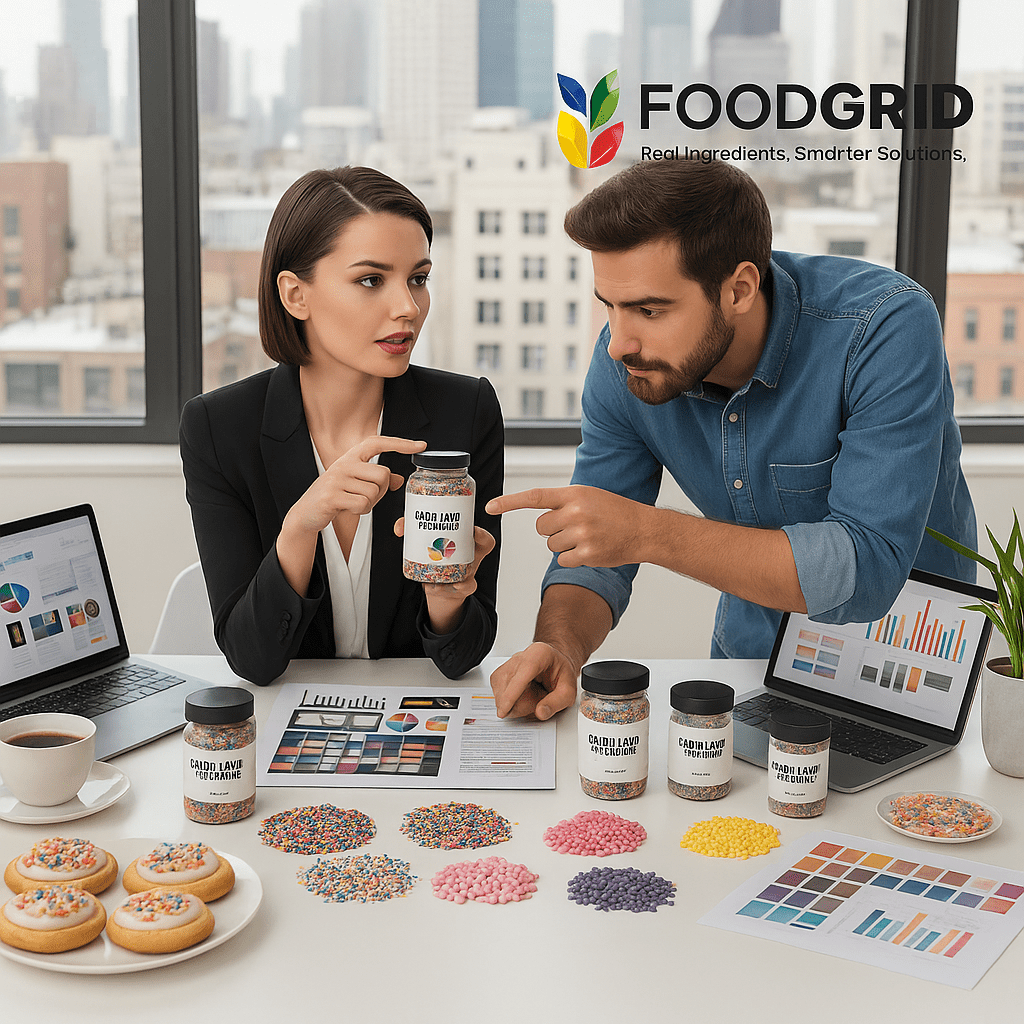
FoodGrid helps brands accelerate the sprinkle sourcing process so product teams can:
- Move from concept to sampling faster
- Evaluate multiple sprinkle options earlier in development
- Reduce the risk of late-stage reformulation
- Align marketing expectations with R&D requirements
- Give QA and regulatory teams access to supporting documentation
- Coordinate ingredient decisions with procurement and operations
- Prepare for scale-up before commercialization
- Keep seasonal and limited-time launches on schedule
The goal is not simply to find a sprinkle quickly. It is to find an option that can move through the development process without creating unnecessary delays later.
For brand teams, that means fewer disconnects between what is shown in the product concept and what R&D can actually manufacture.
A marketing team may want a specific shade or shape. R&D needs to know whether it will perform under the product’s processing conditions. QA may need ingredient and allergen documentation. Procurement needs to understand commercial availability and sourcing requirements.
Getting those conversations started early can help prevent avoidable surprises.
FoodGrid works with brand, R&D, QA, procurement, and operations teams to help ensure that sprinkle performance, ingredient requirements, and brand messaging stay aligned from development through commercialization.
Request sample-ready SKUs for your launch →
From First Sample to Full-Scale Production
A successful sample is only the beginning.
Once a sprinkle is approved for a product concept, the next question is whether it can support the product beyond the lab. Brands need confidence that the selected inclusion can transition from development quantities to commercial production without creating new sourcing or performance problems.
That means considering:
- Ingredient availability
- Commercial order requirements
- Lead times
- Specification consistency
- Documentation
- Color and shape consistency
- Application performance
- Packaging and storage requirements
- Scale-up requirements
This is particularly important for products with seasonal demand or planned retail launches. A sprinkle that works for a small development run but cannot support commercial requirements can force teams back into sourcing after significant development work has already been completed.
By considering scale-up requirements earlier, product teams can make decisions with commercialization in mind rather than treating supply as an issue to solve later.
Meet Your Visual and Labeling Goals
You’ve worked hard to build consumer trust. Your ingredients should reinforce that positioning rather than create questions about it.
For consumers, a sprinkle may look like a small finishing detail. For a brand team, however, it can influence the visual identity, ingredient story, and overall perception of the finished product.
If your product is positioned around natural ingredients, the decorative topping should support that story. If your product is marketed around a specific dietary or ingredient attribute, the sprinkle should be evaluated against those requirements as well.
FoodGrid’s sprinkle catalog supports brands looking for:
- Clean-label ingredient options
- Recognizable ingredient profiles
- Natural color systems
- Non-GMO options
- Vegan-
References:
- NielsenIQ: https://nielseniq.com/global/en/insights/
- Food Processing: https://www.foodprocessing.com/
- Center for Food Integrity: https://www.foodintegrity.org/
- FDA Food Labeling Guide: https://www.fda.gov/food/food-labeling-nutrition


