





Your product passes inspection the day it ships. By day 14 in distribution, the texture has changed. By day 21, a retail buyer flags it for early pullback. By day 28, your account manager is on a call with the category team.
The problem didn’t start at the retailer. Very often, it started with the shortening spec.
Fat directly affects how a baked product ages: how fast it goes rancid, how well it holds moisture, and how quickly it stales. A shortening that performs on production day but degrades faster than your required shelf life creates a problem your retailer catches before your QA team does.
Three Ways Fat Controls Shelf Life
- It slows staling. Fat coats starch during mixing, which slows retrogradation, the process where starch firms up after baking. Slower retrogradation means a softer product for longer.
- It holds moisture. Shortening with a good emulsifier system keeps moisture in the crumb longer. For breads, rolls, and muffins, where softness is the main quality signal, that can be the difference between a product that sells through and one that gets pulled.
- It can go rancid. As fat oxidizes, it produces off-flavors and odors that can make a product unacceptable before its date. A shortening with high oxidative stability resists this longer.
Saturated fats generally offer more oxidative stability than liquid oils high in polyunsaturated fats, which is why palm-based and fully refined plant shortenings are common choices for shelf-stable bakery. But the product name matters less than the specific shortening’s oxidative stability index (OSI). That number tells you more about shelf life than any brand or price point.
Cookies and Crackers: Where Rancidity Shows Up First
Cookies and crackers are low-moisture products, which protects them against mold but leaves fat oxidation as the main factor limiting shelf life. That’s why flavor, not texture, is usually the first thing to go.
A cookie made with a low-OSI shortening can develop stale or rancid notes before its labeled date. A retailer catches it in a category review. A consumer returns it. A buyer who sees a pattern starts renegotiating.
The fix starts with choosing an all-purpose or palm shortening whose OSI matches your shelf life requirement before the first production run. Antioxidants such as tocopherols or rosemary extract can help, but they work best supporting a stable fat, not compensating for an unstable one.
For cracker lines with a surface spray oil, stability matters twice. The spray oil sits on the surface exposed to air, so check the OSI of both your dough shortening and your spray oil before locking in a formula for a long shelf life program.
FoodGrid’s All Purpose Shortening is formulated for cookie, cracker, and snack applications with the oxidative stability and solid fat profile low-moisture products require.
Breads and Rolls: Where Moisture Sets the Window
In bread, the main shelf life issue is staling rather than rancidity. Fat and emulsifiers slow the rate at which the crumb firms and loses softness.
This is where the emulsifier system matters. Two shortenings with the same base fat can produce noticeably different staling rates because of differences in emulsifier type and level. Emulsifiers interact with starch to slow firming, so the right system extends softness and the wrong one leaves you with a loaf that firms early.
For foodservice wholesalers supplying institutional accounts, where rolls may go three or four days from service delivery, this is a direct service risk. A roll that was soft at delivery and firm at service reflects on your product, not the kitchen.
When evaluating a shortening for bread or rolls, ask your supplier for the emulsifier type and level, not just the base fat.
Tortillas: Shelf Life as Rollability
For tortillas, fat’s shelf-life job is structural. Mold is often what ends a tortilla’s life, and that’s managed through formulation, pH, and preservatives. But a tortilla that cracks when rolled at week three has failed too, even with no mold and no off-flavor, and that’s where your shortening comes in.
A shortening that coats starch evenly and holds moisture keeps the tortilla pliable through its shelf life. One that allows moisture loss produces a tortilla that dries and turns brittle before its date.
For foodservice programs, test under refrigerated conditions as well as ambient. A tortilla that passes at room temperature but cracks out of the walk-in hasn’t been tested for its real environment. Test rollability at your customer’s storage temperature, across the full shelf life your label claims.

Donut Frying: Shelf Life Starts in the Fryer
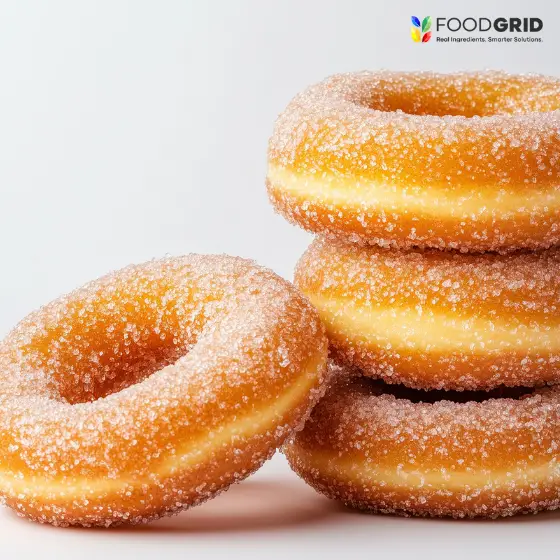
For fried products, finished shelf life depends on the fat’s condition at the moment of frying. A frying fat that has already oxidized in the fryer passes those byproducts into the donut before it leaves your facility, and off-flavors show up sooner.
So there are two questions: how stable is the fat in the fryer, and how stable is it in the finished product?
A high-OSI frying fat lasts longer in continuous frying, produces fewer polar compounds over time, gives more consistent color, and leaves fewer oxidation byproducts in the finished product. Palm-based frying shortenings with controlled polyunsaturated fat are a common choice because they combine heat stability with a clean flavor.
Fryer management still matters. Even a stable fat breaks down faster if the fryer is overloaded or run above the recommended temperature. Get both the OSI and the recommended frying range from your supplier, and stay within that range all shift.
FoodGrid’s Donut Fry Shortening is formulated for industrial frying with the thermal stability and clean finish high-volume donut and snack programs need.
Cakes and Muffins: High-Ratio Shortening
For cakes, muffins, and cupcakes, high-ratio shortening’s higher emulsifier level helps hold moisture in the crumb through cooling, packing, and the retail window. For a packaged cake with a three-week shelf life, that moisture retention can decide whether it sells through or gets pulled early. It matters even more in egg-free formulas, where the shortening takes over the emulsifying work eggs normally do.
For a full explanation of how high-ratio shortening works, see Plant-Based Shortening Specs for Commercial Bakery.
FoodGrid’s All Purpose High Ratio Shortening is formulated for commercial cake, muffin, and cupcake programs, with full documentation at onboarding.
Test Before You Launch
A shortening that looks right on a COA doesn’t guarantee shelf life. The only way to know is to test it in your product under your conditions, before launching or approving a new supplier.
- Real-time testing stores product under the conditions your customers will use and evaluates it at set points across the full labeled shelf life. Space your checkpoints relative to your labeled life, for example at launch, 25%, 50%, 75%, and 100%, plus a point beyond your labeled date for margin. For a three-week cake, that’s roughly weekly. For a six-month cookie, it’s monthly or longer.
- At each checkpoint, evaluate what matters for your format: softness in breads, crunch and flavor in cookies and crackers, pliability in tortillas, and flavor in fried products.
- Accelerated testing stores product at elevated temperatures to speed up aging and get early directional results, which is useful when comparing shortening options quickly. Use it to narrow your choices, then confirm with real-time results.
Test at the temperature your customer actually stores the product, not just lab ambient. A cookie sits in a climate-controlled store. A tortilla at a foodservice account sits in a cold room.
A supplier who supports your shelf life testing with technical data, not just a COA, can help you solve problems before they reach your retail account.
Talk to FoodGrid About Your Shelf Life Spec
FoodGrid supplies all-purpose shortening, all-purpose high-ratio shortening, palm shortening, and donut fry shortening for commercial bakery, snack, tortilla, and frying operations at retail, foodservice, and industrial scale. All are trans fat free.
Every product comes with a COA per lot, solid fat content data, oxidative stability information, emulsifier disclosure, allergen statements at product and facility level, and RSPO certification status, ready at onboarding.
Whether you’re troubleshooting an existing shelf life problem or qualifying a supplier for a new program, contact our ingredient team or review the full shortening range at foodgridinc.com.
Real Ingredients. Smarter Solutions.


