



Your formula is locked. The texture is right. The flavor hits the brief. Then your retail buyer sends one question: “Does it have artificial colors?”
If the answer is yes, you have a problem. Regulators are tightening rules on synthetic dyes. Retailers are pulling products that carry them. And reformulating after the fact costs you time, money, and shelf space. The good news? One ingredient swap can fix this before it becomes a fire drill: natural sanding sugar.
Here is what you need to know to use it in a commercial setting.
Synthetic Dyes Are a Growing Risk
The FDA is actively reviewing color additives — Red 40, Yellow 5, and Yellow 6 are all under scrutiny. California’s AB 418 already bans several synthetic dyes in school food programs. More states are drafting similar laws.
If your product ships across multiple states or you plan to grow distribution, synthetic dyes are a liability. You may need to reformulate within one or two product cycles, whether you plan to or not.
The smarter move: build clean-label compliance into the formula now. Don’t wait for a regulatory deadline to force your hand.
The FDA’s color additive resources give you the full picture on where regulations stand today.
What Natural Sanding Sugar Is
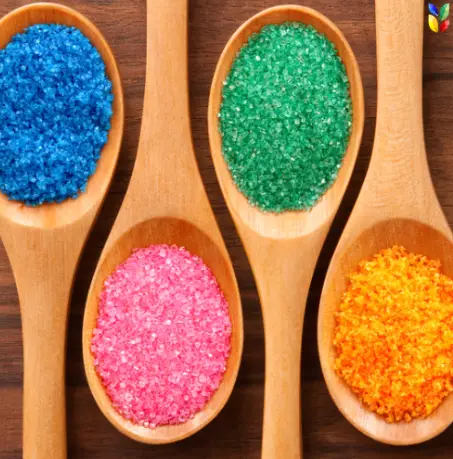
Sanding sugar is a coarse-grain decorative sugar. You apply it to the surface of baked goods — cookies, muffins, cupcakes, breads, and seasonal items. The large crystals catch and refract light. That is what creates the sparkle effect. It gives a product a premium, handcrafted look even at high commercial volume.
Natural sanding sugar uses plant-based, botanical, or mineral-derived pigments. It delivers the same visual result as conventional sanding sugar — color, sparkle, texture — without FD&C dyes on the ingredient label.
FoodGrid’s Natural Rainbow Fall Sanding Sugar covers a full range of autumn tones: amber, gold, burgundy, and deep purple. Every color comes from natural sources. That means the product supports “no artificial colors” label claims without any extra steps on your end.
How It Performs in Commercial Baking
Natural sanding sugar works the same way as conventional sanding sugar in most cases. But there are a few things to know before your first production run.
Heat stability: Natural pigments behave differently from synthetic dyes at high heat. Above 375°F (190°C), some colors may shift slightly. For high-heat applications, apply sanding sugar after baking as a glaze step instead of before. For standard oven temps between 325°F and 365°F, oven-stable natural sanding sugar holds its color well with no process change needed.
Application and bonding: Apply sanding sugar right after egg wash or glazing — before the product goes into the oven. This bonds the crystals to the surface during baking. For no-bake items, a light mist of water or simple syrup works just as well.
Coverage rate: Start at 3–5 grams per standard unit. Less coverage gives a clean, polished finish. More coverage creates a frosted look. Adjust based on your visual spec.
Substrate compatibility: Natural sanding sugar works on butter-based, egg-based, yeast-leavened, and gluten-free products. You do not need new equipment or a process overhaul to make the switch.
Storage: Keep it in a cool, dry space away from direct light. Shelf life is stable and comparable to standard decorative sugars when you store it in sealed packaging.
The Institute of Food Technologists publishes solid research on natural colorant stability in baked goods if you want to go deeper into the science.
What Clean-Label Claims This Ingredient Unlocks
Clean label is no longer just a consumer trend. Retail and foodservice buyers now require it. FMCG Gurus’ 2023 research found that nearly two-thirds of consumers check ingredient lists before they buy. Retail buyers are responding by requiring “no artificial colors” on products they stock.
Natural sanding sugar lets you make that front-of-pack claim. It also keeps your formula competitive in premium, artisan, and health-focused market channels — places where ingredient sourcing is part of the brand story.
One important note: “natural” does not automatically satisfy every certification. Before you lock in a supplier, confirm the colorant sources match your specific certification requirements — organic, kosher, halal, or vegan. A good supplier gives you full source disclosure upfront, not after you ask three times.
FoodGrid’s SweetGrid platform covers clean-label finishing ingredients with full compliance documentation at onboarding — COAs, allergen statements, and country-of-origin docs ready for retail buyer audits from day one.
How It Simplifies Your Seasonal SKU Calendar
R&D teams managing a seasonal product calendar deal with a real complexity problem. Q3 and Q4 launches — Halloween, harvest, Thanksgiving, holiday — all need visual differentiation. Developing custom colors or sourcing separate decorators for each season adds cost and lead time.
One natural sanding sugar SKU with the right color range solves this. The warm amber-to-burgundy spectrum in Rainbow Fall Sanding Sugar covers multiple seasonal applications without custom development work. You get the seasonal look your marketing team wants without adding complexity to your supply chain.
Mordor Intelligence projects the specialty bakery segment will grow at over 5% CAGR through 2028. Visual appeal drives much of that growth. Seasonally decorated products sit right in that lane — and natural ingredients give them a positioning edge.

What Innova and Euromonitor Data Tell You About the Market
The market data backs this up clearly. Innova Market Insights consistently ranks “no artificial colors” among the top five claims that drive purchase intent in North American and European bakery categories.
Euromonitor International tracks clean-label as one of the top five global food trends, with no signs of it plateauing. Consumers across every age group are reading labels more carefully than they did five years ago. Retail buyers know this. They are selecting products accordingly.
For food scientists, this means clean-label compliance is no longer just a regulatory checkbox. It is a commercial advantage. Products with natural ingredients earn shelf space faster and face fewer barriers in new retail channels.
The Regulatory Landscape Beyond the U.S.
The FDA is not the only body food scientists need to watch. The European Food Safety Authority (EFSA) already placed stricter limits on Allura Red and tartrazine — the European equivalents of Red 40 and Yellow 5 — citing behavioral concerns in children. U.S. regulators tend to follow EFSA’s lead, often within a few years.
If your company has any international distribution — or plans to — formulating with natural colorants removes a real obstacle. You avoid the cost of separate regional formulations. You ship one clean product everywhere.
See EFSA’s food colors guidance for the current European standard.
What to Require from Your Supplier
Switching to natural sanding sugar is a straightforward formulation decision. But qualifying the supplier takes real diligence. Natural colorants carry more inherent variability than synthetic dyes. A quality supplier controls for that variability with documented QC processes. A poor one passes the problem on to your production floor.
Before you approve any natural sanding sugar supplier for commercial use, ask for:
- Full colorant source disclosure — What plant, botanical, or mineral source produces each pigment
- Color specification ranges — The documented acceptable variance per lot so you know what to expect batch to batch
- COA per batch — Certificate of Analysis covering color, granulation, and purity
- Allergen statement — A written declaration for the product and the facility
- Country of origin documentation — Required for most retail customer compliance audits
- Food safety certification — SQF, BRC, or equivalent; FDA facility registration for U.S. retail supply chains
Plan lead times carefully, especially for Q4 production. Supply chain pressure hits a peak in the back half of the year across the industry. Set buffer stock levels and reorder windows early — before your production window opens, not after.
FoodGrid delivers all of this documentation at onboarding. No chasing. No delays. Visit foodgridinc.com to see what that looks like in practice.
The Case for Acting Now, Not Later
The formulation swap itself is easy. No new equipment. No process redesign. You apply natural sanding sugar the same way you apply conventional sanding sugar.
The business case is just as clear. You gain a front-of-pack clean-label claim. You cut your regulatory risk. You open doors with retail buyers and foodservice operators who require natural ingredients. And you protect yourself from the cost of forced reformulation down the road.
The only real investment is in supplier qualification. Do that once, and every product you put it in benefits.
Food scientists who wait for regulatory pressure to force the move will spend more to fix it later. The ones who build it into the next formulation cycle get the label claim, the market positioning, and the compliance coverage at the same time.
Request a Sample Today
FoodGrid supplies Natural Rainbow Fall Sanding Sugar with full documentation — COA, allergen statement, colorant source disclosure, and spec sheet — ready before your first order.
Request a sample or connect with our ingredient team at FoodGrid Inc.
Real Ingredients. Smarter Solutions.