


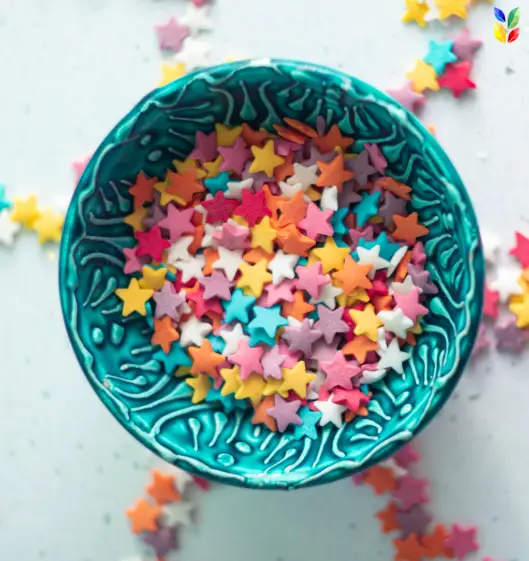
The vast majority of food producers approach Passover compliance with a one-and-done mentality. This is not only shortsighted but costly. Those who recognize that certification with an Orthodox Union symbol for Passover can be used for ongoing business success are winning the day with increased shelf space, exclusive private labeling agreements, and higher profit margins. This blog post explores the implications of this for your sprinkles supply chain and bottom line.
What “Kosher for Passover” Actually Means for Sprinkles
Passover is not only more restrictive than regular Kosher certification. It constitutes a completely new certification type with its unique ingredients, production process, and auditing requirements. According to the Jewish religious tradition, during the Passover holiday, there should be no presence of chametz – leavened grains such as wheat, barley, rye, oats, and spelt. In addition, according to traditional Ashkenazi rules, kitniyot is also forbidden during Passover; those products include corn, rice, legumes, and sometimes even certain starches.
In such a way, for sprinkles producers, there emerges an entirely new challenge. Standard sprinkles usually consist of corn starch, modified food starch, confectioner’s glaze, and carmine, the ingredients that could be prohibited in Passover products in some cases. Similarly, natural sprinkles, natural colored sprinkles, and all-natural sprinkles are also in jeopardy because of some restrictions on particular ingredients.
If your sprinkles are to be marketed as OU-P sprinkles, meaning they have passed Orthodox Union Kosher for Passover certification, you must meet special criteria for all ingredients used in your products, and the entire production process must be observed by a certified mashgiach (Kosher inspector).
Why the OU Mark Is the Most Valuable Trust Signal in the Category
The Orthodox Union is the world’s largest and most recognized Kosher certification agency. Its OU symbol appears on more than 1.3 million products sold in over 100 countries. When a retail buyer sees the OU-P mark on your natural chocolate sprinkles or organic rainbow sprinkles, they do not have to research your compliance. They already trust it.
That trust has a dollar value. According to research from the Kosher Food Industry Report published by Mintel, consumers who purchase Kosher-certified products represent a market that extends well beyond practicing Jewish households. Seventh-day Adventists, Muslims, vegans, and allergen-conscious shoppers also actively seek Kosher marks as a quality and purity signal. In the United States, this broadens the addressable consumer base significantly.
For your R&D and QA teams, what that means in practice is this: getting OU-P certification on your line of natural sprinkles or supernatural sprinkles is not just about serving a niche. It is about unlocking access to a wider premium retail segment that uses the OU mark as a buying filter.
The Business Case: Retail Growth Through Certification
The retail buyers for specialty chain stores, natural food markets, and club stores work with restricted shelf space and a strong SKU mandate. In analyzing sprinkles manufacturers, they seek out a differentiator. The OU-P certification stamp provides your all-natural rainbow sprinkles an edge in three key areas.
First, it enables access to new distribution routes. National retailers such as Whole Foods Market, Sprouts, and kosher-certified specialty chains demand or highly recommend products bearing a recognizable certification mark. Having your all-natural rainbow sprinkles or all-natural colored sprinkles certified by the OU-P allows you to be distributed in the Kosher aisle segment of the market that your competitors, lacking certification, cannot reach.
Secondly, this will make way for premium pricing of the product. Certification comes with its costs, and retailers know that very well. Products certified with OU-P always fetch higher prices on shelves compared to non-certified products. This is an upstream advantage because, when your consumers — bakeries, private label producers, and snacks — realize they can charge more because of being certified, they will pay more for all-natural sprinkles certification as well.
Thirdly, this is going to foster brand loyalty among your buyers. No one buying OU-P natural chocolate sprinkles from you as a producer is going to look elsewhere because getting re-certified by a new producer is costly and cumbersome.

What OU Certification Requires from Sprinkles Manufacturers
The process of obtaining OU certification is tough, and its toughness is precisely why it is useful. Below is information that food companies should have before going for it.
Ingredient level certification. All ingredients in the natural sprinkles or organic rainbow sprinkles must be approved by the OU. Therefore, a company has to submit its complete list of ingredients (i.e., Bill of Materials). If you use any colorant derived from insects (carmine), it is unlikely to pass. Most artificial colors are prohibited or at least need approval. This is among the reasons why there is a trend towards using natural colors for sprinkles.
Facility inspection. The OU dispatches a mashgiach for a facility inspection. In particular, for Passover certification, the inspection involves evaluating the cleaning procedure, equipment, and schedule, since Passover food cannot use equipment to process chametz unless a proper kosherization process has been completed.
Ongoing supervision. Unlike other OU labels, the OU-P label cannot be considered a one-time certification. It entails continuous supervision during Passover production. Manufacturers who produce Passover SKUs annually should incorporate a mashgiach schedule in their production schedule.
Documentation. Your QA department must keep accurate ingredient and supplier certification documents. To earn an OU-P label, the OU needs documentation that all ingredients used in your natural dye sprinkles and/or natural colored sprinkles conform to the standard.
For food manufacturers who have not gone through this process before, the OU Kosher certification application portal provides a detailed step-by-step overview of requirements and timelines.
Natural Ingredients and Kosher Compliance: A Natural Fit
The reason why natural sprinkles and Kosher certification come up together is that there is quite a bit of similarity in the composition of such sprinkles. Plant-based color additives such as those derived from turmeric, spirulina, beet, and annatto are usually suitable for Kosher diets. Corn-free and rice-free formulas used in all-natural rainbow sprinkles can be created in such a way as to exclude kitniyot. The sugar should come from certified sources to be allowed in Passover recipes.
This is a result of careful research by many companies. Those who introduced clean label formulas in their range early on discovered that it was much easier to make them Kosher compared to regular products. This implies that formulating your natural sprinkles or supernatural sprinkles to become clean label and formulating to make the products Kosher will often go hand-in-hand for your R&D department.
The Food and Drug Administration’s guidance on food colorants provides a useful reference for understanding which natural color sources are approved and under what conditions — a useful starting point for aligning FDA compliance with Kosher ingredient standards simultaneously.

Addressing Common Objections from Manufacturing Teams
“It takes too much time.” The OU process usually takes several weeks to months, depending on the complexity. If your Passover product, you normally plan 6 to 9 months. Companies that regard certification as a reactionary process will always be playing catch-up. Companies that regard certification as a capability will dominate.
“Our buyers did not ask for this.” Customers who did not ask for certification usually do not even know about its value – until another company offers certification to them, making the whole discussion revolve around capability and not the price tag. Proactive certification gives you the upper hand in negotiations.
“There is no way we can control all our vendors.” That is the valid objection, and this is precisely why the OU process begins with supplier mapping. Sometimes companies see certification as a means of ensuring control over ingredient sourcing, which then helps control allergens, quality, and traceability – valuable attributes for any QA department regardless of Kosher considerations.
What This Means for Your Sprinkles Line
If you manufacture or use any of the following products in your company – natural sprinkles, only natural sprinkles, natural rainbow sprinkles, or other decorative toppings- then a certification such as OU-P is well worth considering, not as a matter of religion, but as an economic advantage.
Those companies that dominate the sprinkles market over the next five years will be those who leverage compliance as an economic strength and not just as a legal requirement.
FoodGrid Inc. partners with manufacturers and private label companies in providing clean label ingredients such as natural colored sprinkles, organic rainbow sprinkles, and all-natural rainbow sprinkles that comply with Kosher and Passover requirements. If you are looking for a supplier who will assist you in gaining certification or one that is already certified, the choice of sourcing company will make all the difference.
Ready to Take the Next Step?
Come to us with your existing product formulation, your target SKU range, and your retailer requirements, and let us help you identify what’s missing. Connect with our specialist or request a sample here.