



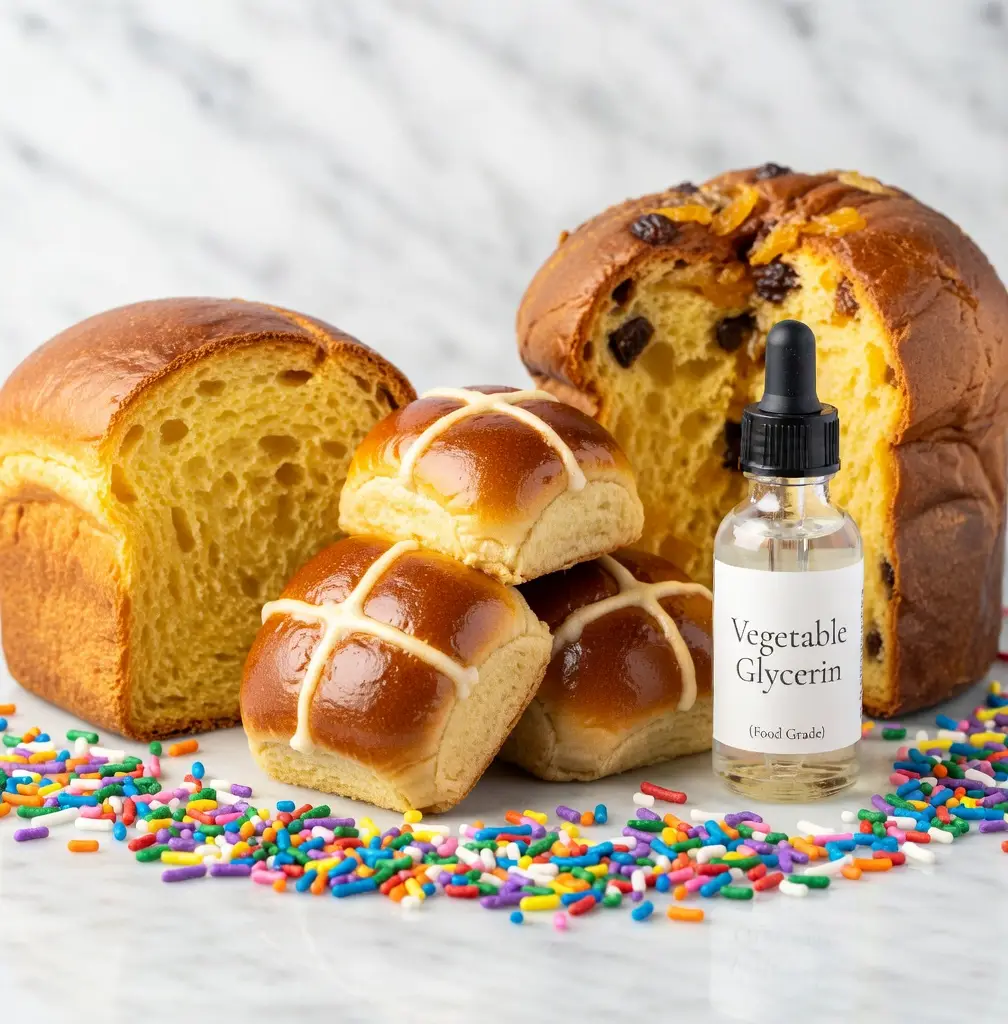
One Bad Batch Can Cost You a Whole Season
Months of work go into getting that perfect panettone recipe. Your sourcing is spot-on; you have the cleanest ingredients. The lamination on your brioche is right on the money. But three days after your retailer gets the shipment, returns come rolling in because the product seems dry and compact.
A single failed run isn’t a lost sale. A single failed run costs you that listing.
There’s no denying it: enriched dough products like brioche, hot cross buns, and panettone have a short shelf life and an inherent need for moisture. Unless your recipe has mechanisms in place to manage water activity during its entire shelf life, you’re going to keep losing this fight. Vegetable glycerin addresses both those issues cleanly and effectively.
Here, we’ll take a deep dive into exactly what makes vegetable glycerin a great choice for managing humectants in enriched doughs and what makes it relevant to seasonal formats.
What Is a Humectant and Why Does It Matter in Sweet Breads?
Humectants are additives that absorb water molecules from the environment and retain them in a food matrix. In bakery products, this translates to the humectants retaining the moisture by slowing down the loss of water from the crumb.
The ingredients used in most sweet bread products provide natural humectant qualities since eggs, sugars, and fats have humectant properties. However, the three ingredients listed above will not provide sufficient moisture retention for your sweet bread for a span of 14 to 21 days, particularly during winter, when most of your sweet bread products will be sold.
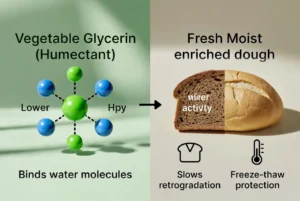
Glycerol, or vegetable glycerin, is a clear, odorless additive that is produced from plants and contains high levels of hydroxyl groups in its chemical composition. The high hydroxyl content helps it create hydrogen bonds with water molecules.
According to the FDA’s GRAS designation database, glycerin has a Generally Recognized as Safe (GRAS) status. When you source it from vegetable oils — typically palm-free coconut or soy — it also fits clean-label and plant-based positioning, which matters to the sustainability directors and brand managers reading this.
The Science Behind Glycerin in Enriched Doughs
Ingredients such as butter, eggs, and sugar are present in significant quantities in enriched dough products such as brioche and panettone. While these components give enriched dough products a tender texture, they are also prone to staling since fatty acids can potentially disrupt the gluten and starch complex and result in starch retrogradation.
Here is what glycerin does inside that matrix:
- It lowers water activity (Aw). Water activity measures how available free water is in a product. Microbial growth needs free water. By binding water molecules, glycerin reduces Aw without removing moisture from the product. This extends microbiological shelf life while keeping the crumb moist. Target Aw for most sweet breads sits between 0.85 and 0.92. Glycerin helps you stay in that range longer.
- It slows starch retrogradation. Glycerin competes with starch chains for water molecules. When starch cannot access free water easily, retrogradation slows. Your crumb stays soft. Your brioche does not turn into a brick on day five.
- It stabilizes the dough during freeze-thaw cycles. Many commercial producers of hot cross buns and panettone use partial-baking or frozen dough formats. Glycerin acts as a cryoprotectant, reducing ice crystal formation that would otherwise tear through the gluten network and destroy texture after thawing.
Research published by the Institute of Food Technologists has consistently supported the role of polyols — the class of compounds glycerin belongs to — in crumb softening and shelf-life extension across enriched bakery formats.
Format-by-Format Breakdown
Brioche
Fat content and crumb are very important for brioche. The problem with the storage of brioche is the fact that its rich fat content speeds up the drying process.
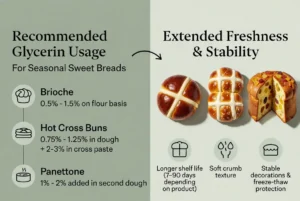
Incorporate 0.5% to 1.5% vegetable glycerin relative to the weight of the flour used. Vegetable glycerin blends well in the course of emulsification. Just add it together with other liquids before you incorporate the butter. In this amount, it won’t influence the fermentation or yeast action. It will help your crumb remain soft for 7 or more days.
Hot Cross Buns
The problems posed by hot cross buns are two-fold: first, keeping the spiced dough moist; second, keeping the cross (made usually by piping a flour-paste cross) soft and moist, preventing cracking.
Here is glycerin to the rescue. Use it in the dough at an addition of 0.75% to 1.25%, based on the flour. For the flour cross paste, incorporate glycerin at 2% to 3%, based on the weight of the cross paste itself. It will help maintain the softness of the cross without changing its white color and ability to pipe. This is particularly important when dealing with Easter runs, where products have to be stored in warmer areas for several days.
In addition, if you use natural food coloring and sprinkle hot cross buns and other holiday rolls with sprinkles, glycerin in your glaze base will keep the colors attached to the surface. This issue is particularly noticeable with natural blue sprinkles, natural heart sprinkles, and organic Easter sprinkles, because their color is known to run off the surface due to moisture content variation.
Panettone
Panettone is the most complicated of the three types we are comparing. The traditional method of making panettone employs a mother yeast and requires that there be two fermentations. There are high standards in Italy concerning moisture content and the shelf life of the product. It usually needs to last between 60 and 90 days for commercial use.
For this reason, the glycerol becomes one part of an entire strategy involving the use of emulsifiers like DATEM or SSL, together with natural preservatives such as ethanol or even modified atmosphere packing.
The glycerin should be used at a ratio of 1% – 2% per flour mass when manufacturing panettone. The ingredient should be added during the second impasto. In this way, the glycerin will not interfere with the formation of gluten, which is crucial for the production of panettone.
For companies that manufacture premium panettone and then decorate their products with natural holiday sprinkles or natural decorating sprinkles, the glycerin in the finish coating will keep the sprinkles in shape while main the quality throughout the extended shelf life. This is particularly true when dealing with export brands that deliver their products to the UK market because homemade sprinkles UK trends have pushed consumer demand toward cleaner, natural sprinkles, dye-free options that still look polished.
Sourcing Vegetable Glycerin: What Your Team Needs to Know
Not all vegetable glycerin is the same. Your sourcing team needs to evaluate three things:
- Origin and traceability. Palm-derived glycerin is widely available and cheap, but it carries deforestation risk that can conflict with your ESG commitments. Coconut-derived or certified sustainable palm glycerin gives you a cleaner story. Ask suppliers for RSPO certification or equivalent.
- Purity grade. Food-grade glycerin should be 99.5% or higher in purity. Industrial glycerin — a byproduct of biodiesel production — can contain methanol residues. Always specify USP or food-grade in your procurement documents.
- Kosher and halal certification. Seasonal sweet breads often sell in multicultural retail channels. Certifications matter. Confirm them before you lock in a supplier.
The USDA Agricultural Marketing Service maintains updated standards for what qualifies as certified organic production. If your formulas carry organic certification, verify that your glycerin supplier can provide NOP-compliant documentation.
Labeling Considerations for Clean-Label Brands
“Glycerin (vegetable)” is what you will find vegetable glycerin listed as on the label. The consumer, in general, has come to view glycerin as a plant-based ingredient, especially in those natural and specialty food channels where premium seasonal breads are sold.
If your brand is using SKU-specific ingredients like organic sprinkles, dye-free, or natural dye sprinkles near me, you are very aware of the need for all ingredients to be defensible on your product label. Glycerin is an easy choice.
For any brand distributing its products to the UK or EU market, glycerin (E422) is an approved food additive with no maximum quantity allowed in bakery products according to EU Regulation No. 1333/2008. Post Brexit, this allowance still applies in the UK.
If you are marketing natural dye sprinkles Christmas seasonal SKUs, then vegetable glycerin sourced as non-GMO offers no issue in terms of labeling.
Practical Formulation Tips Before You Scale
Before your team moves glycerin into full-scale production trials, keep these points in mind:
- Start at the low end of the dosage range. At levels above 2% of flour weight, glycerin can introduce a faint sweetness and a slightly sticky mouthfeel. Neither is desirable in a product where texture precision matters.
- Adjust your water addition. Because glycerin holds water, you may need to reduce your dough hydration by 1% to 2% to maintain the same handling consistency. Trial and adjust.
- Monitor Aw at day one and day fourteen. You want to confirm that glycerin is actually holding Aw within your target range across the full shelf life, not just immediately post-bake.
- Document supplier specs. If you are selling into retail with a clean-label claim, your buyers will eventually ask for ingredient documentation. Have your glycerin supplier’s food-grade certificate and origin documentation ready.
How FoodGrid Supports Ingredient-Led Formulation
At FoodGrid, we work with food brands that take ingredient decisions seriously. Our sourcing and technical teams help you identify the right functional ingredients — including plant-derived humectants — to match your formula requirements, your label commitments, and your retail targets.
If you are developing or reformulating seasonal sweet breads, our ingredient sourcing resources can connect you with verified suppliers and technical documentation so your team can move from trial to production with confidence.
The Bottom Line
Vegetable glycerin is not some fad ingredient. Rather, vegetable glycerin is a well-known, safe-to-eat humectant that addresses an issue faced by many formulas: retaining moisture, structure, and stability in enriched sweet doughs during retail periods.
With the proper usage and timing in your process, vegetable glycerin will help extend the viability of your product during its period of retail without needing to make any change to your labeling message. Vegetable glycerin will provide your brioche with more days. It will protect the integrity of your designs on your hot cross buns over the Easter holiday period. Finally, vegetable glycerin will allow for the extended shelf life necessary for exporting your panettone.
Ready to Upgrade Your Seasonal Bread Formula?
Are you a sourcing manager, sustainability director, or brand manager in charge of the baking portfolio for your company? Let’s connect!
FoodGrid pairs food companies with reliable ingredient partners, expert sourcing assistance, and clean label documentation to facilitate more efficient formula formulation choices.
Contact the FoodGrid team today to discuss your humectant sourcing needs, request ingredient specifications, or start a conversation about your next seasonal product launch.