





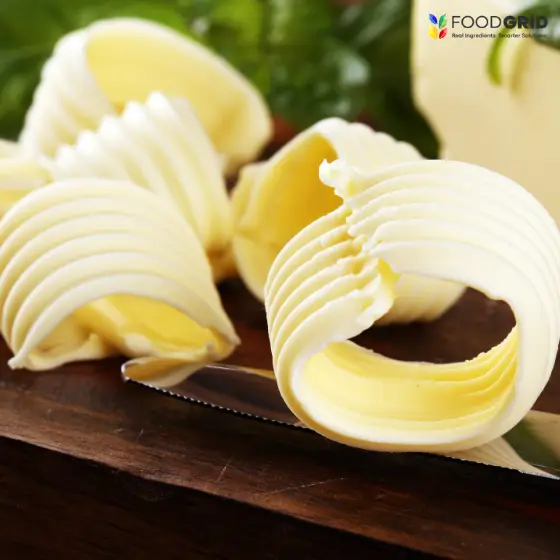
Butter was near $8,000 USD per metric ton in early 2025. By December 2025, it had dropped to roughly $4,300 USD per metric ton. That is nearly half the peak price in twelve months. North American butter export prices rose more than 65 percent between 2021 and 2024.
If you run a croissant line, a danish program, a puff pastry process, or a foodservice laminated dough program, pricing your products with butter as your primary fat means your input costs move every quarter.
Puff pastry margarine does not behave this way. It is produced from a stable vegetable fat base with a consistent cost structure. For operations directors managing output consistency, procurement managers who need to hold pricing commitments, and R&D teams building specs that do not shift quarter to quarter, that stability is worth more than the line item difference between butter and lamination margarine.
This post covers the butter price problem in factual terms, the functional performance of puff pastry margarine at commercial scale, and what your team needs to evaluate before making the switch.
The Butter Price Problem Is Structural, Not Temporary
Butter price swings are not a short-term disruption. They are a structural feature of the global dairy commodities market.
European countries and New Zealand supply roughly 70 percent of global butter exports. Both regions run on milk production cycles tied to calving seasons, weather, and feed input costs. A supply disruption in either region hits global butter availability within one to two quarters. Drought in New Zealand pastures or high energy costs in Europe show up in your ingredient cost before the season ends.
The 2024 and 2025 price environment showed exactly this pattern. European butter peaked above 7,500 euros per metric ton in mid-2025 before falling sharply as milk production recovered and EU butter stocks built up. North American pricing held firmer on domestic demand strength but still followed a long-term upward trend that averaged five percent per year from 2012 to 2024, according to market data from IndexBox.
In 2026, the divergence continued. North American butter prices strengthened on rising producer costs while European prices came under pressure from elevated inventories. For commercial bakeries sourcing butter across multiple regions or running programs that require consistent input costs across a multi-quarter pricing cycle, that divergence creates a margin planning problem that no procurement strategy fully resolves as long as butter remains the primary lamination fat.
Dairy Reporter noted in its April 2026 analysis that food manufacturers in the bakery and confectionery sectors showed growing interest in plant-based butter alternatives as a direct cost management response to elevated pricing. That interest was not driven by label trends or regulatory pressure. It was driven by margin protection.
What Puff Pastry Margarine Actually Delivers at Commercial Scale
Most teams start the butter versus margarine conversation with the wrong question. The question is not whether margarine can match butter in taste. The question is whether margarine can match or surpass butter on the performance variables that matter in commercial production.
Those variables are plasticity, consistency, lamination integrity, roll-in temperature range, and lift volume.
Plasticity Consistency
Butter’s plasticity range, the temperature window where it handles correctly without cracking or smearing, is narrow. A butter block two degrees too cold cracks during sheeting. A butter block two degrees too warm smears into the dough instead of creating discrete fat layers. Maintaining butter at the exact required temperature across a full production shift requires careful control of both the ingredient and the production environment.
Puff pastry margarine is engineered with a wider plasticity range than butter. It handles correctly across a broader temperature window, which reduces the sensitivity of your lamination process to ambient temperature variation in the facility. For operations directors running a high-throughput lamination line, that wider working range means fewer lamination failures, less rework, and more consistent output per shift.
Lamination Integrity
In laminated dough, the fat layer must stay distinct from the dough layer through every fold and sheeting pass. If the fat breaks through or smears, the layer structure collapses, and the finished product does not lift correctly in the oven.
Puff pastry margarine is formulated with a solid fat content profile designed to maintain layer integrity through commercial lamination processes. The fat stays in place during sheeting and folding without cracking or smearing at the temperature ranges typical of a commercial lamination operation. For many commercial operations, lamination margarine delivers more consistent layer integrity than butter because the spec does not shift the way butter’s natural composition does between seasons or suppliers.
Roll-In Temperature Range
Butter requires a narrow roll-in temperature window, typically around 60 degrees Fahrenheit or 15 to 16 degrees Celsius, to perform correctly. Puff pastry margarine operates across a wider roll-in range because its fat crystal structure is engineered rather than natural. For production teams working in facilities without precise cold room temperature control, or during warmer production months when ambient facility temperature rises, that wider roll-in range reduces lamination failures without requiring equipment upgrades.
Lift Volume and Oven Spring
The rise, the shatter, and the distinct layers visible in a cross-section of a laminated product all come from steam created between fat layers during baking. The consistency of that lift depends on the consistency of the fat layer structure going into the oven.
A well-specified puff pastry margarine delivers consistent lift volume across production runs because the fat spec is controlled and documented. Butter lift performance varies with butterfat percentage, moisture content, and dairy source, all of which shift between suppliers and between seasons.
FoodGrid’s Puff Pastry Margarine is engineered for consistent puff volume, with a stable solid fat content and an optimized slip melting point that delivers dependable lift and oven spring across production runs. It carries a natural butter flavor system, is GMO-free and trans fat free, and meets clean-label requirements without compromising lamination performance.

The Cost Per Unit Math Procurement Managers Need to Run
Comparing butter to bulk bakery margarine on a per-unit basis requires four variables evaluated together, not separately.
- Ingredient cost per kilogram. This is the starting point. In most markets, puff pastry margarine costs meaningfully less per kilogram than butter at comparable quality levels. During the 2025 butter price peaks, the gap widened significantly. During periods of lower butter pricing, the gap narrows but does not close.
- Usage rate per batch. Butter and margarine are not always used at identical rates in laminated dough formulas. Margarine for puff pastry laminated dough can sometimes be used at a slightly adjusted rate to achieve equivalent layer count and lift. Your R&D team needs to run trials to confirm the usage rate for your specific formula before you finalize the cost comparison.
- Consistency of supply and pricing. Butter pricing moves on dairy commodity cycles. Margarine pricing moves with vegetable oil markets, which carry their own volatility but on different cycles with different drivers. For a procurement manager managing a multi-quarter supply commitment to a foodservice or retail customer, the key question is which input lets you price your output with more confidence. In most market environments, vegetable-fat-based margarine pricing is easier to forward-commit than butter pricing.
- Waste and rework reduction. Lamination failures from butter handling issues generate rework that does not appear in the ingredient cost line but shows up in your cost of goods sold. A fat with a wider plasticity range and more consistent lamination performance reduces that waste cost. It is a real cost difference that an ingredient price comparison alone does not capture.
Procurement Resource tracks butter price trends across global markets and documents the volatility pattern commercial bakeries face when butter is their primary lamination fat. Their data supports what production managers already know from experience: butter pricing forces reactive procurement decisions rather than planned ones.
What R&D and QA Teams Need Before Approving a Switch
For R&D and QA teams, the margarine specification approval process requires the same rigor as any commercial ingredient change. Performance variables are documented and testable, and compliance documentation requirements are clear.
- Solid fat content profile. Request SFC values at multiple temperatures covering your mixing, lamination, and baking process conditions. This tells you how the fat behaves at each stage of your process before you run a production trial.
- Slip melting point. The temperature at which the fat transitions from solid to liquid determines when steam generation begins in the oven and directly affects lift timing. Confirm that the slip melting point of your margarine spec aligns with your oven temperature and bake cycle.
- Plasticity range documentation. Ask for the temperature range within which the fat handles correctly for roll-in and sheeting. This defines the production process envelope your operations team needs to work within.
- COA per lot. Certificate of Analysis covering solid fat content, moisture, free fatty acid level, and peroxide value for every production lot that ships. This is your incoming QC reference document and your compliance record for retail and foodservice customer audits.
- Allergen statement at product and facility level. Both. Lamination fat is a base ingredient in every laminated product you produce. It must carry a clean allergen statement that covers your full product range.
- Trans fat and GMO status documentation. For programs requiring clean-label compliance or non-GMO verification, confirm these in writing before you formulate. A supplier who cannot provide written confirmation is not a supplier you can defend in a retail or foodservice compliance audit.
Vesper Tool’s bakery margin analysis documents the predictable seasonal volatility pattern in butter pricing and notes that procurement teams who understand these patterns can build better sourcing strategies around them. For teams managing both butter and margarine as active options, the seasonal pattern data supports a hybrid sourcing approach that uses margarine as the base fat and supplements with butter in specific premium-tier products where butter flavor is a defined product attribute.
FoodGrid provides all compliance documentation at onboarding for its Puff Pastry Margarine, including COA per lot, allergen statement, GMO status, and trans fat certification. Visit foodgridinc.com/purchasing to review the supplier qualification process.
Where Puff Pastry Margarine Makes the Strongest Case
Not every laminated product needs to move to margarine. The strongest case applies to three specific program types.
- High-volume foodservice laminated dough programs. Foodservice puff pastry programs run on volume, consistency, and cost per unit, not premium positioning. Institutional croissants, puff pastry shells, danish bases, and laminated snack formats served in school programs, hospitals, and restaurant chains are positioned on texture, visual appeal, and delivery cost. Puff pastry margarine delivers all three without the pricing exposure of a dairy-linked input.
- Private label retail bakery. Private label laminated products compete on price point. A private label croissant or puff pastry product at a retail tier that requires tight margin control cannot absorb butter price swings without raising retail price or cutting margin. Puff pastry margarine holds the cost structure stable regardless of what dairy markets do in a given quarter.
- Seasonal and limited time offer programs. A seasonal laminated product launched for a four- to six week retail window carries less unit volume than a year-round SKU. That lower volume means procurement cannot always secure forward butter contracts at favorable rates for a short-season run. Puff pastry margarine is available at stable pricing without the minimum forward commitment requirements that dairy commodity purchasing often demands.
FoodGrid’s Puff Pastry Margarine is available in commercial volumes for laminated dough programs across retail, foodservice, and industrial bakery applications. FoodGrid’s All Purpose High Ratio Shortening also supports bakery programs that require a versatile high ratio fat for non-laminated applications within the same production facility.
Request Samples and Pricing Today
FoodGrid supplies puff pastry margarine and bulk bakery margarine for retail, foodservice, and industrial laminated dough programs. Complete technical documentation is available before your first order, including COA per production batch, slip melting point specification, allergen statement, and GMO and trans fat certifications.
If you need to evaluate margarine as a replacement for butter in your current laminated dough line, source a foodservice puff pastry fat for a new program, or build a cost-protected ingredient specification for a private label laminated product, FoodGrid’s ingredient team is ready to help.
Contact our ingredient team or review the full puff pastry margarine specification at foodgridinc.com.
Real Ingredients. Smarter Solutions.


