





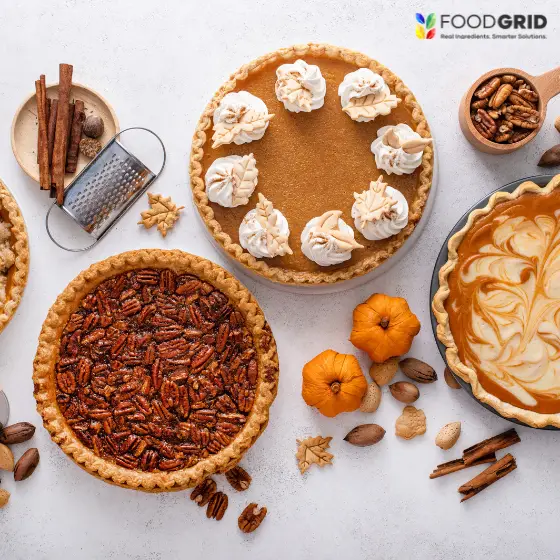
Most bakeries do not double their shortening order for Thanksgiving. They triple it. A pie shop that bakes a steady weekly volume in September can see that number jump sharply the week before Thanksgiving, and by the time that spike actually hits, it is too late to fix a shortening order placed too small or too late.
Pie production runs almost entirely on a single ingredient decision: how much shortening is on hand, and whether it behaves consistently across a much larger batch count than a normal week ever requires. October is the month that volume planning needs to happen, not the week before the holiday.
Thanksgiving Is Not a Bump. It Is the Biggest Week of the Year.
Industry coverage of seasonal pie production confirms just how sharp this spike really is. Craft to Crumb reports that award-winning pie shops see holiday volume increase by double or triple their normal weekly output, with Thanksgiving standing out as the single biggest week of the year for most bakeries in this category.
This is not a gradual ramp either. Retail data tracked around the Thanksgiving period shows real strain across the entire pie supply chain during this exact window. Supermarket Perimeter reported elevated and worsening out-of-stock rates across frozen pie shells, bakery pies, and related categories in the run-up to Thanksgiving, driven by demand that outpaces what suppliers across the category can reliably deliver on short notice.
Why Shortening Specifically Becomes the Bottleneck
Flour and fruit filling are relatively easy to scale up quickly. Shortening is not, for a few concrete reasons.
Consistency matters more at higher volume. A small inconsistency in texture or flakiness that goes unnoticed across ten pies a day becomes visible across two hundred pies a day, especially if a rushed reorder brings in a slightly different lot or an unfamiliar shortening brand to cover a shortfall.
Storage space gets tight fast. A volume increase this large means holding far more inventory than usual, which puts real pressure on storage conditions and rotation discipline right when both matter most.
Suppliers face the same spike from every customer at once. Every pie-focused bakery in the category is placing a larger shortening order during the same few weeks, which means a supplier’s capacity gets stretched right when your own order needs to be largest and most reliable.
Building the Volume Plan Backward From Thanksgiving Week
Start by mapping your actual expected volume increase, not a rough guess. Pull the exact multiplier from last year’s production data if you have it, since a specific number plans far better than a general sense that “it gets busy.” Industry coverage from Baking Business confirms that pie remains a steadily growing category even amid broader bakery pricing pressure, which means this seasonal spike is not a one-time event to plan around loosely. It is a recurring, measurable pattern worth tracking precisely year over year.
Once you have a real volume number, confirm your shortening order against it directly, built with enough lead time that a supplier can plan production rather than scramble to fill a late request. Waiting until early November to place this order puts you in competition with every other pie-focused bakery making the same late decision.
All-Purpose Shortening Versus High-Ratio Shortening for Pie Work
Most pie crust work calls for a standard all-purpose shortening rather than a high-ratio shortening, since pie crust depends on flakiness and structure rather than the sugar and liquid holding capacity a high-ratio product is built for. Confirm your team is ordering the correct category for your actual pie formula, since the two are not interchangeable, and a mixed-up order discovered mid-production is a difficult problem to fix during your busiest week of the year.
If your bakery also runs a cake or sweet filling line alongside pies during the same holiday stretch, confirm your supplier can deliver both categories on the volume and timeline your full holiday calendar requires, rather than assuming one order covers every application.
Palm Shortening and Storage Stability During a High Volume Stretch
Holding a much larger shortening inventory for several weeks raises real storage stability questions. Palm shortening carries a naturally higher saturated fat content than many alternative vegetable oil shortenings, which gives it stronger resistance to oxidation during an extended storage period, a real advantage when inventory is sitting longer than usual to cover a volume spike.
Confirm your supplier’s documented shelf life data specifically for the volume and storage duration your Thanksgiving plan requires, rather than assuming a standard shelf life estimate covers a much larger than normal inventory position.
What to Confirm With Your Supplier Before Volume Triples
- Confirmed production capacity for your full projected Thanksgiving volume, not just your standard weekly order
- A written delivery schedule, broken into stages if your volume requires multiple shipments ahead of the holiday
- Consistent lot sourcing, so a rushed reorder does not introduce a different shortening brand or formulation mid-season
- Documented shelf life data matched to how long your larger inventory position will actually sit in storage
- A named point of contact for the specific weeks your volume peaks
FoodGrid Supplies Shortening Built for Peak Pie Season
FoodGrid’s All Purpose Shortening and All Purpose High Ratio Shortening deliver the consistent flakiness and texture your pie formula depends on, even at several times your normal weekly volume. Our Purchasing team plans Thanksgiving volume around your actual production calendar, not a generic shipping estimate.
Our Quality Control group backs every batch with full documentation, so a larger order never means a less consistent one.
Lock In Your Thanksgiving Volume This Month
Do not let a late shortening order become the reason your pie line cannot keep up with your biggest week of the year. FoodGrid confirms production capacity and delivery dates before your volume triples.
Request a sample or connect with our ingredient team at FoodGrid Inc.
Real Ingredients. Smarter Solutions.


