



Your retail buyer just sent another compliance document. Your school foodservice account added a new addendum. And your brand team forwarded a news article about synthetic colorants with one question: “Are we exposed?”
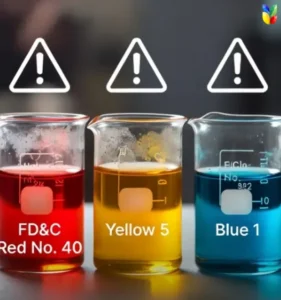
If your products use FD&C Red No. 40, Yellow No. 5, Yellow No. 6, Blue No. 1, Blue No. 2, or Green No. 3, the answer is yes.
On April 22, 2025, the FDA announced a nationwide program to remove all six color additives from the U.S. food supply by 2027. This is not a trend. It is a federal campaign with a public industry tracker and named company commitments. For R&D teams, reformulation is no longer optional.
What the FDA Actually Said
The U.S. Department of Health and Human Services and the FDA announced this phase-out in April 2025. The goal is to remove all petroleum-derived artificial dyes from American food by December 2027.
The FDA is working directly with food producers, retailers, and trade associations to carry this out. The agency already withdrew its approval for FD&C Red No. 3 in early 2025 and plans to remove Orange B and Citrus Red No. 2 as well.
The FDA’s industry tracker page lists every company that made a public commitment, which brands are affected, and where each one stands. As of early 2026, that list includes General Mills, Nestlé, Mars, PepsiCo, Conagra, Campbell’s, Walmart, Kraft Heinz, Hershey, Kellanova, WK Kellogg, Danone, Tyson Foods, and dozens more.
Some companies have already finished. Sam’s Club removed FD&C colors from its Member’s Mark line. Tyson Foods completed its transition by May 2025. In-N-Out removed synthetic colors from its Strawberry Shakes and Signature Pink Lemonade. PepsiCo launched new Cheetos and Doritos without artificial colors or flavors.
General Mills pledged to remove synthetic colors from all cereals and products going to U.S. schools by summer 2026 and from all U.S. retail products by end of 2027. Nestlé is targeting mid-2026 for all U.S. food and beverages. Walmart is reformulating all private-label products under Great Value, Marketside, and Freshness by January 2027.
If brands this large are hitting those deadlines, their suppliers need to move at the same pace.
Why This Is Not Just a Label Update
Some teams see this as a simple swap. Pull the FD&C dye. Drop in a natural source. Update the ingredient statement. Done.
That is not how it works in production.
Natural colorants come from plants, minerals, or botanical sources. They behave differently from artificial dyes because they carry more natural variance than a petroleum-based dye manufactured to a tight lab specification. pH level, temperature, light exposure, water activity, and processing time all affect how a natural colorant performs in your formula.
There is no natural drop-in equivalent for FD&C Blue No. 1. There is no direct substitute for Red No. 40. There is no one-to-one replacement for Yellow No. 5.
Before you put a natural color into production, you need to test it under your actual processing conditions. That means your oven temperatures if you run a bakery application. Your extrusion parameters if you produce snacks. Your pasteurization cycle, if you produce beverages. Your enrobing and cooling line if you produce confectionery. Each category has its own variables, and no two formulas perform the same.
The Institute of Food Technologists has published extensive research on natural colorant performance in processed food systems. That research gives you a useful baseline. It does not replace formula-specific testing.
The Categories With the Most Urgency
Not every category faces equal pressure, but several need to move first.
Bakery. The American Bakers Association committed directly to the FDA to remove FD&C colors from all baked goods going to K-12 schools by the 2026 to 2027 school year. Grupo Bimbo set a full portfolio removal deadline of the end of 2026. If you supply bakery products to schools or to retailers that serve school programs, your reformulation timeline is already under pressure. A natural colors supplier with documented school-grade compliance is a qualification requirement at this point, not a nice-to-have.
Confectionery. Mars committed to offering M&Ms, Skittles, and Starburst in versions without certified colors starting in 2026. The Hershey Company set a 2027 deadline across its full snacks portfolio, including Jolly Rancher, KitKat, and Twizzlers. Confectionery natural colors present some of the most complex formulation challenges. These products depend on vivid, stable color across a range of temperature and humidity conditions. You need a clean-label ingredient supplier with real confectionery experience.
Snacks. PepsiCo has already completed the switch to new Cheetos and Doritos products. Utz Brands is committed to eliminating all FD&C colors from its full portfolio by 2027. Hershey’s SkinnyPop line falls under the same deadline. Natural colors for snacks must survive extrusion, frying, seasoning application, and extended shelf life. These are serious technical requirements for any natural color solution to meet.
Beverages. Kraft Heinz included Crystal Light, Kool-Aid, and MiO on its commitment list with a 2027 deadline. PIM Brands is removing artificial dyes from all Welch’s Fruit Snacks by early 2026. Natural colors for beverages face solubility, pH sensitivity, and light stability challenges that require careful selection and testing before you scale.
What Clean Label Compliance Requires From Your Supply Chain
The reformulation is one part of the work. The supply chain is the other.
The FDA’s tracker page notes that companies can contact the FDA’s Food and Cosmetic Information Center to report their commitments. Manufacturers are going on record with public timelines. If your supplier cannot keep pace, you have a production problem on top of a formulation problem.
When you qualify a natural food color supplier, you need more than a sample and a price sheet. You need documentation that holds up under retailer and school district audits. That means a Certificate of Analysis per lot, full colorant source disclosure, allergen statements, country of origin records, and a food safety certification from SQF, BRC, or an equivalent body.
The FDA’s color additive regulations outline the difference between exempt color additives and certified ones. Natural colors derived from plant, mineral, or animal sources are generally exempt from certification, but they still must meet applicable use and labeling requirements. Know that distinction. Source from suppliers who document it.
Lead time is a real variable. Natural colorant production is not as standardized as synthetic dye manufacturing. Crop yields, extraction processes, and seasonal availability all affect supply. If your Q4 production window opens in August and you start sourcing in July, you risk delays that force a synthetic fallback. Build buffer stock. Set reorder windows earlier than you think you need to.
The Business Case for Moving Before the Deadline
The 2027 deadline is the floor, not the ceiling.
Schools are already running on a 2026 timeline. Target is removing FD&C colors from all cereals sold in stores and online by May 2026. Walmart’s private brand reformulation finishes in January 2027. If you want placement in those channels, your product needs to qualify before their deadlines, not yours.
Retail buyers are moving faster than the regulatory timeline because their shoppers are demanding it. The clean label movement has been building for over a decade. Parents check school lunch programs. Shoppers read ingredient lists. The pressure that drove this FDA initiative came from real consumer demand at the store level.
For food developers, the commercial argument is clear. A product with natural color solutions earns shelf space in premium retail, foodservice, and institutional channels. It avoids the cost of reformulating under deadline pressure. And it protects your brand from the attention that follows when a product gets pulled for ingredient compliance.
The Consumer Brands Association, whose members cover a significant share of U.S. packaged food sales, is encouraging its full membership to stop using certified color additives in all products by December 31, 2027. That is an industry-wide signal.
Natural food reformulation ingredients that meet clean label standards are not a niche category anymore. They are standard operating procedures for any brand that plans to grow.

What to Ask Your Ingredient Supplier Right Now
If you are starting a reformulation project, ask these questions before you lock in a supplier.
Ask for the colorant source behind every shade you want to use. “Natural” is not enough. You need to know whether the red comes from beet, radish, carmine, or paprika. Each one performs differently and requires its own label declaration.
Ask for color specification tolerances per lot number. Natural colors can vary batch to batch. Get that range in writing.
Ask for heat and pH stability data specific to your application. A color that works in a cold-fill beverage may shift badly in a hot-fill process. A color stable in neutral-pH cookie dough may perform differently in a high-acid fruit filling.
Ask whether the supplier has experience in your specific category. A supplier with deep bakery expertise may not carry the same capability in confectionery or beverage applications. Match the supplier to the application.
FoodGrid’s SweetGrid product line covers a full range of naturally colored decorating ingredients designed for commercial production. Every product ships with full compliance documentation at onboarding. No digging for paperwork. No delays during audit season.
The Window Is Shorter Than It Looks
The year 2027 sounds like a long time. It is not.
A standard reformulation cycle covers colorant identification, lab testing, pilot production, stability studies, retail approvals, packaging changes, label printing, and old inventory phase-out. In the best case, with clean supply chain lead times and cooperative retail buyers, that process takes six to twelve months.
If your products go to school distribution or to a major retailer with an existing deadline, your real window may already be 2025 or early 2026.
The manufacturers listed as complete on the FDA tracker did not start in 2027. They started years earlier and built natural color solutions into their production systems while competitors waited.
R&D teams that move now build clean label compliance into their next product cycle. The teams that wait will spend more to fix it under pressure, with fewer supplier options and longer lead times as demand for reformulation ingredients spikes closer to the deadline.
Ready to start your reformulation before the deadline closes in? Talk to FoodGrid about sourcing naturally colored ingredients built for commercial production. Contact the FoodGrid team here and let us match you with the right color solution for your application and timeline.