


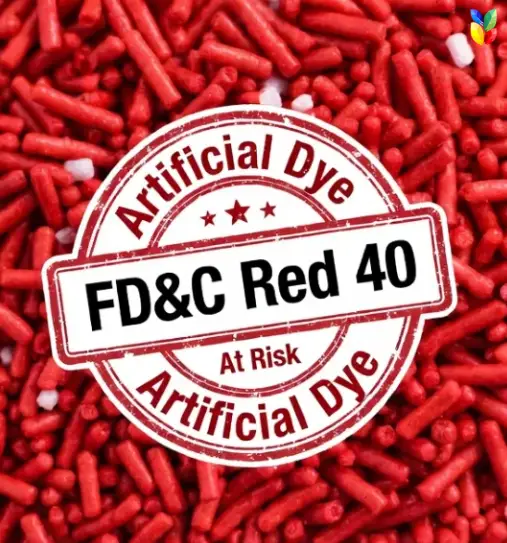
The call comes on a Tuesday. Your retail buyer is flagging your sprinkle topping. FD&C Red 40 is no longer accepted under their updated supplier guidelines. Your next line review is in six weeks. And you are not the only brand getting this call.
Most food brands do not reformulate their decorative ingredients until a buyer forces them to. By then, the timeline is tight, the costs are higher, and shelf space is already at risk. The brands moving now are not caught off guard. They saw the shift coming and acted on their own schedule.
California banned artificial dyes from school food programs in 2023. Three more states have active legislation. The FDA is reviewing Red 40, Yellow 5, and Yellow 6. More than 60 percent of consumers check ingredient labels before buying, and that number is higher in households with children. Your buyers know this. Their supplier standards now reflect it.
For nonpareils and decorative sprinkles, this is one of the simplest formula changes you will make. One ingredient swap. No new equipment. No line changes. No retraining. What follows is the full picture: regulatory pressure, market data, technical specs, and what to ask any supplier before you place your first order.
The Regulatory Window Is Closing, and It Is Moving Fast
The FDA review of synthetic FD&C dyes is no longer a distant risk. Red 40, Yellow 5, and Yellow 6 are all under active scrutiny. California AB 418, signed in 2023, banned six artificial food dyes from school food programs. It was the first state action of its kind in the U.S. Other states are following.
The European Food Safety Authority has already tightened standards on Allura Red and tartrazine, the European equivalents of Red 40 and Yellow 5, citing behavioral concerns. The U.S. pattern is consistent: EFSA moves first, and the FDA follows within a few years.
For food brands with distribution across multiple states, export programs, or retail customers with supplier compliance requirements, the question is no longer whether to reformulate. It is whether you do it on your schedule or theirs.
Brands that wait for a final FDA ruling before acting will face tight reformulation timelines, higher qualification costs, and a gap in shelf placement during the transition window.
What the Market Data Says About Clean Label ROI
This is not a niche health food trend. It is a mainstream purchasing shift that is reshaping conventional retail.
Innova Market Insights consistently ranks “no artificial colors” among the top five purchase drivers in North American and European bakery categories. FMCG Gurus found that more than 60 percent of consumers check ingredient labels before purchasing packaged food. That number is significantly higher in households with children under 12.
The commercial impact for manufacturers is direct:
- Premium, natural, and specialty retail channels give better shelf placement to products with clean color claims.
- Club store and mass market buyers are updating their supplier standards to require natural colors, not just specialty retailers.
- Foodservice operators in the K-12 and healthcare segments are adding clean color to their approved ingredient lists.
Natural nonpareils are no longer a premium option. In a growing portion of the buyer market, they are a basic requirement for distribution access.
What the Transition Looks Like in Practice
A mid-size specialty bakery brand reformulated its seasonal sprinkle line ahead of a major club store review. The switch to natural colored nonpareils required one qualification cycle with their existing supplier, roughly six weeks from first sample to approved spec. The label change supported a “no artificial colors” front-of-pack claim. The buyer cited that claim as a factor in the shelf placement decision at the next line review. No new equipment. No process change. One label update.
This same story is playing out across categories, from celebration cakes to trail mix to frozen novelties. The cost to switch is low. The distribution gain is real.

Technical Performance: What R&D Teams Need to Know Before Speccing
Natural colorants behave differently from synthetic dyes under heat, light, pH, and moisture. None of these factors requires a process overhaul. They do require accurate data from your supplier before you lock in your specification.
Heat Exposure
Most plant-based pigments hold up well at standard baking temperatures between 325 and 365 degrees F. Above 375 degrees F, anthocyanins found in fruit and vegetable-derived colorants may fade or shift in color. For high-heat applications, apply nonpareils after baking as part of a glazing or finishing step. This is already common practice in many decorating lines and requires no equipment change.
pH Sensitivity
Anthocyanins shift color in acidic or alkaline conditions, moving from red or purple toward blue or green as pH rises. Know the pH of your base product before finalizing your natural nonpareil spec. A qualified supplier will give you pH tolerance data for each colorant as standard. If they do not offer this, that tells you something.
Light and Moisture
Natural pigments are more sensitive to UV light than synthetic dyes—products in clear packaging benefit from a light barrier or opaque layer to protect color through distribution. Nonpareils are also hygroscopic, meaning they pull moisture from the air, which can cause clumping and color bleed onto the product surface. Controlled humidity in storage and proper packaging specs solve this. Any qualified supplier will include storage guidance in their standard documentation.
Seasonal SKU Management: How the Right Supplier Reduces the Workload
Managing a seasonal product calendar with multiple color palettes across multiple ingredient suppliers adds time, cost, and documentation requirements that most procurement teams would rather avoid.
A natural nonpareil supplier with a full color range means you can source all seasonal colors from one qualified vendor. Winter reds, greens, and whites. Spring pastels. Summer brights. Fall ambers, golds, and purples. One supplier relationship, one documentation set, consistent color from lot to lot.
Natural Individual Colored Nonpareils are built for this. A broad palette of natural colors sourced consistently, with lot-to-lot color control across the full seasonal calendar.
Supplier Qualification: What to Require Before Your First Order
The ingredient switch is simple. The supplier qualification is where your due diligence matters. Natural color variability is real. A supplier who can document and control for it keeps that variability out of your production. One who cannot make it your problem.
Before approving any natural nonpareil supplier, get the following in writing before your first order:
- Colorant source disclosure. Plant, botanical, or mineral origin for each pigment. Required for accurate label declarations and supports organic, kosher, halal, or vegan claims.
- Color specification ranges per lot. Documented acceptable variance so your receiving team knows what to expect at intake.
- Certificate of Analysis per batch. Covers color, granulation, moisture content, and purity. This is your quality control document at receiving.
- Allergen statement. Written declaration for the product and the facility. Required for most retail and foodservice supplier audits.
- Country of origin documentation. Required for most retail compliance programs.
- Food safety certification. SQF, BRC, or equivalent. FDA facility registration for U.S. retail supply chains.
- Heat stability and pH tolerance data. For the specific colorants in your spec, not generic claims from a product sheet. Ask for it directly.
Plan your lead times as well. The natural ingredient supply chain tightens in Q3 and Q4 as seasonal demand picks up. Booking inventory ahead of your production windows keeps your schedule intact.
The Business Case
Natural colored nonpareils are a direct substitution. Same application method. Same equipment. Same line speed. The only change is your ingredient label, and with it your label claims, your distribution options, and your regulatory position.
The brands reformulating now are not just meeting a requirement. They are gaining a real business edge: cleaner labels, broader market access, and protection against future regulatory action, all in one move.
Ready to Qualify a Supplier?
FoodGrid Inc. supplies Natural Colored Nonpareils and Natural Individual Colored Nonpareils with full documentation ready before your first order: Certificate of Analysis, allergen declaration, colorant source information, heat stability data, and complete product specifications.
If your next formula or reformulation includes decorative toppings, request a sample and begin your qualification today.
FoodGrid Inc.
Real Ingredients. Smarter Solutions.