



You have until 2027. But when you factor in formulation timelines, retail buyer review cycles, artwork changes, and new supplier qualification processes, that deadline compresses fast. Most brands selling decorative food products tied to artificial dyes don’t yet have a qualified alternative supplier in place.
Natural sanding sugar is one of the priority items to get right. It’s what consumers see first, what they photograph, and what shapes first impressions of your product on the shelf. If the color doesn’t hold, the brand impact is immediate.
This checklist is designed to help you evaluate natural sanding sugar suppliers before 2027 forces the decision.
Why Sanding Sugar Is a Priority in the Phase-Out
Sanding sugar is one of the most FD&C-dependent decorative ingredients in commercial baking. The large crystal structure requires colorants that bond firmly to the surface and maintain visual consistency through distribution and storage. Synthetic dyes were engineered specifically to do that job.
The FDA’s voluntary phase-out guidance targets eight petroleum-derived dyes most commonly used in food: Red 40, Yellow 5, Yellow 6, Blue 1, Blue 2, Green 3, Orange B, and Red 3. Every one of those dyes appears in commercial decorative baking sugar and rainbow sanding sugar products currently on the market.
Switching to natural food color sugar isn’t just a label update. It’s a sourcing operation — new raw material suppliers, different performance criteria, and a qualification process that takes longer than most teams expect. Teams that wait until regulatory pressure forces the change will start that process in the second half of 2026, under a deadline.
Start now.
What Changes When You Move to Natural Sanding Sugar
Before working through the qualification checklist, your sourcing team needs to understand what they’re actually buying.
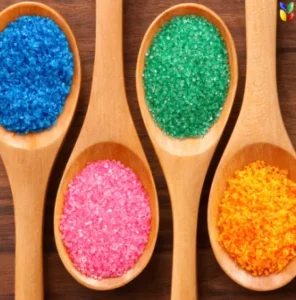
Clean-label natural sanding sugar uses botanical, plant-based, or mineral-based colorants in place of certified synthetic dyes. Common sources include turmeric for yellow and gold, spirulina for blue and green, beet extract for red and pink, and anthocyanins — from red cabbage or butterfly pea flower — for blue-purple shades.
These colorants carry inherent variability. Color can shift based on harvest conditions. Some are pH-sensitive, meaning the perceived hue can change depending on the product substrate. Heat stability varies significantly between colorant types.
This doesn’t mean natural sanding sugar can’t perform at a commercial scale — it can. But the ability to deliver consistent color at volume depends on tight specification and sourcing control, not on the inherent stability of the colorant. You are buying a color system, not a simple crystalline raw material. The checklist below is built around that distinction.

The Supplier Qualification Checklist
- Verify the Colorant Source Declaration
Request a complete colorant source list for every color in the product line — not a category label like “natural red” or “botanical blue,” but the specific plant or mineral origin of each colorant.
This matters for two reasons. First, the colorant source defines performance characteristics. A supplier who can’t tell you whether their red is derived from beets or carmine hasn’t controlled the formula at its source. Second, the colorant source determines whether the ingredient is compatible with your product’s label claims. Carmine is derived from insects, which creates immediate conflicts for vegan, kosher, and certain halal certifications.
A qualified B2B ingredient supplier provides this disclosure as standard, not on request.
- Request a Color Specification Sheet with Tolerance Ranges
Natural colorants vary between production batches. That’s a technical reality, not a supplier failure. What separates qualified suppliers from unqualified ones is whether they have defined variance ranges and test against them consistently.
Ask for a color specification sheet showing the target color value for each SKU, the tolerance range above and below the target, and the test methodology used. Industry standard is CIELAB color space values (L*, a*, b*). If a supplier provides only a visual reference card without numerical specifications, treat that as a disqualifier.
For rainbow sanding sugar or multi-color seasonal blends, request individual color specifications for each component. Without them, a single out-of-spec color can’t be identified visually once the blend is finished.
- Require a Certificate of Analysis for Every Production Lot
A Certificate of Analysis documents that a specific production lot has been tested and confirmed to meet the specification. At commercial volumes, a COA is not supplemental paperwork — it is the only verifiable proof that what was delivered matches what was ordered.
For natural sanding sugar, the COA should include color testing data, particle size distribution, moisture content, and microbiological clearance. A supplier who provides COA only on request, or who supplies a single master COA covering multiple batches, is not providing meaningful quality documentation.
Require per-lot COA as a condition of doing business, not as an exception.
- Confirm Food Safety Certification Status
Any supplier producing decorative baking sugar at a commercial scale for retail distribution should hold a current third-party food safety certification. The three recognized certifications are SQF (Safe Quality Food), BRC (British Retail Consortium), and FSSC 22000. Each confirms that the supplier operates under an audited food safety management system.
Ask for the actual certificate, not just the certification number. Certificates carry expiration dates. An expired certificate means the supplier is not currently certified.
Also confirm active FDA facility registration. Under FSMA, any facility that manufactures, processes, packs, or holds food for U.S. consumption must be registered with the FDA. This is a compliance baseline. If a supplier cannot confirm active registration, remove them from consideration.
- Verify Allergen Statement and Facility Controls
Natural colorants introduce allergen risks that synthetic dyes do not. Annatto has been associated with reactions in aspirin-sensitive individuals. Some botanical extracts are processed in facilities that also handle tree nuts or soy. For products positioned toward allergy-conscious consumers, documentation needs to cover both the product formulation and the manufacturing facility.
Require two separate allergen statements: one for the product itself, and one for the facility where it’s produced. A supplier who provides only a product-level allergen statement is leaving a gap your retail buyers will find during their own review process.
The Food Allergy Research and Education (FARE) organization publishes practical resources on commercial food allergy management controls. Reviewing that guidance before finalizing your qualification criteria will help your team ask sharper questions.
- Audit the Supply Chain Transparency Policy
Natural colorant supply chains are typically longer and less linear than synthetic dye supply chains. A synthetic dye has an industrial petrochemical provenance with a short, traceable path. A natural colorant can move through multiple intermediaries between field and production line, and each link in that chain is a potential point of substitution or documentation loss.
Ask your supplier how far they can trace their ingredients. Do they know exactly where the beet extract in their red sanding sugar was grown? Do they know which facility processed it into its finished form? If a supplier cannot trace their inputs back two tiers, they lack the transparency needed to support your sustainability reporting requirements.
Investor expectations and regulatory developments are increasing pressure on consumer brands to demonstrate Scope 3 supply chain traceability. A decorative sugar supplier with first-tier-only visibility creates a gap in that chain.
- Confirm Non-GMO and Certification Alignment
If your brand carries a non-GMO claim, or if your retail partner requires one, your decorative baking sugar needs to support it. Non-GMO verification is based on ingredient verification, not supplier assertion. Confirm that the specific product carries a valid non-GMO verification from a recognized certification body and that the certificate is current.
Apply the same standard to any other relevant claims — organic, kosher, halal, vegan. Each has its own documentation requirements. A “natural” label does not automatically satisfy any of them. Ask for the certificates and confirm the scope and expiration dates.
- Test Lead Times Against Your 2027 Reformulation Schedule
This step isn’t part of document review, but it may be the most operationally important item on this list. Natural sanding sugar at B2B volumes is a supply-constrained ingredient. Availability for specific botanical colorants is tied to agricultural seasons. Production capacity fills well ahead of Q3 and Q4 peaks.
Work backwards from your planned shelf date using confirmed lead times from your shortlisted suppliers. Build in time for artwork revisions, retailer review, production trials, and packaging changes. In most cases, sourcing teams need to have their natural sanding sugar supplier under contract 12 to 18 months before their target launch date.
For brands planning 2027 compliance, that conversation starts now.
What Good Documentation Looks Like at Onboarding
A supplier who passes all eight points above should be able to provide the following before your first order:
- Colorant source declaration for all colors in the product line
- Color specification sheet with CIELAB tolerances for every SKU
- Sample Certificate of Analysis from a recent production lot, per SKU
- Current food safety certification with an expiration date
- FDA facility registration confirmation
- Allergen declaration covering both product formulation and facility controls
- Supply chain traceability documentation to at least two tiers
- Non-GMO verification and any other applicable certifications, with scope and expiration dates
Any supplier who asks you to wait until the first order before providing this documentation is already signaling problems. Don’t place the order to find out what they are.
The Window Is Real
This isn’t speculation. The FDA has published its timeline. Major retail buyers are already incorporating clean-label criteria into their 2026 and 2027 line reviews. Brand managers who arrive at those reviews without a qualified natural alternative in place will have a product removal conversation, not a negotiation.
Proper supplier qualification takes time. Working through documentation, running production trials, and finalizing a contract doesn’t happen in thirty days. The brands that complete this process ahead of the deadline will have a compliant product on the shelf and clean buyer reviews when 2027 arrives. The brands that delay will be qualifying suppliers under deadline pressure, working with incomplete documentation, and paying a premium for constrained supply.
Start the checklist now.
Ready to Qualify a Natural Sanding Sugar Supplier?
FoodGrid Inc supplies natural sanding sugar, rainbow sanding sugar, and the full SweetGrid decorative baking sugar line at B2B volumes. Every product ships with complete onboarding documentation: colorant source declaration, per-lot COA, food safety certification, allergen statement, non-GMO verification, and two-tier supply chain traceability.
If your team is building its 2027 compliance supplier list, contact FoodGrid’s sourcing team to request samples, specification sheets, and a full qualification package.
Connect with FoodGrid’s ingredient sourcing team and get your qualification process started today.
Real Ingredients. Smarter Solutions.