


Select ten cookies from a shelf that are adorned with sprinkles and find out the number of cookies that have the identical circular or oblong-shaped sprinkle. It is the sameness of the sprinkle used that poses a challenge faced by most marketers but not often acknowledged. When all the products go for the same jimmy or nonpareil, the shelf filled with different brands starts resembling ten products of a single brand, a problem that shows up on shelves in the U.S. and Canada alike.
It is the custom natural sprinkle shapes that provide a solution to an issue that cannot be resolved using flavor or packaging alone. The custom natural shapes offer a signature to the product that cannot be imitated by competing products. This is why all the departments are looking at the importance of this choice.
Packaging Gets the Design Budget. Sprinkles Rarely Do.
Brand teams invest heavily in packaging design, since the research backs that investment up clearly. An Ipsos survey conducted on behalf of the Paper and Packaging Board found that 72% of Americans agree that a product’s packaging design often influences their purchase decisions (Ipsos). That investment logic rarely extends to the decorative ingredients sitting on top of the product itself, even though those ingredients are often the first thing a shopper actually sees once a product comes out of its wrapper or into a bakery case display.
A standard round sprinkle blends into the background regardless of how strong the packaging looks. A custom natural shape does the opposite. It gives a product a visual signature that carries through from shelf to unboxing to the first bite, reinforcing brand identity at every step of the shopper’s interaction with the product.
What Natural Shape Sprinkles Actually Are
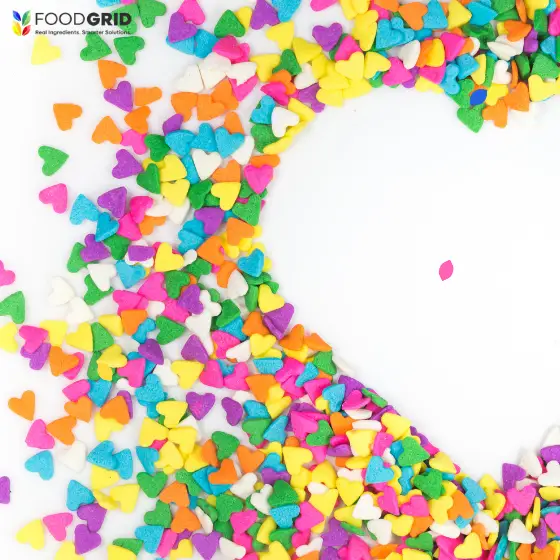
Natural shape sprinkles use the same clean label approach as any other natural colored sprinkle, built on plant, fruit, and mineral-based pigments instead of synthetic FD&C dyes, but formed into a custom silhouette instead of a standard round or oblong piece. Stars, hearts, leaves, letters, and fully custom brand shapes are all achievable using natural dye sprinkles as the base color system.
This matters for two reasons. First, a custom shape carries the same clean label claims as any other natural sprinkles line, including non-GMO sprinkles and organic sprinkles positioning where the supplier can document it with certification specifics that differ depending on whether you’re labeling for the U.S. (USDA Organic) or Canadian (Canada Organic Regime) market. Second, a shape becomes a piece of visual intellectual property in a way a standard sprinkle color never can. Competitors can match a color relatively easily. Matching a proprietary shape requires copying a specific mold or die, which is a much bigger step for a competitor to take.
Why Natural Colors Make the Shape Decision Easier, Not Harder
A brand team considering custom shapes sometimes assumes natural colorants limit design options compared to synthetic dyes. That assumption is increasingly out of date. All natural sprinkles now achieve a full range of bright, saturated colors, including a true green sprinkle, a shade that was historically harder to produce well from plant based sources and has improved significantly in recent years though it’s worth noting that natural pigments remain inherently more sensitive to heat, light, and pH than synthetic dyes, which is why stability testing on the actual shape and color combination still matters before a full launch (Majzoobi et al., 2025, Foods).
This means a brand does not have to choose between a distinctive shape and a clean label claim. Both are achievable in the same product, which removes what used to be the strongest argument for staying with a synthetic dye-based decorator. Nontoxic sprinkles positioning and a custom visual identity can now exist in the same SKU without a formulation compromise on either side.
The Business Case for Brand and Category Managers
Category managers evaluating shelf performance look for anything that increases dwell time, the number of seconds a shopper’s eyes stay on a product before moving to the next one. Visual distinctiveness is one of the strongest levers available for this, more reliable than price alone in categories where most products already compete on similar cost.
A custom natural shape gives a brand a repeatable way to create that distinctiveness across an entire seasonal or year-round portfolio, rather than relying on a single hero SKU to carry the differentiation for the whole line. A Halloween shape, a heart shape for Valentine’s Day, and a signature brand shape used year-round can all share the same natural decorate platform, which keeps sourcing and formulation simple even as the visual identity shifts by season and works the same way whether that seasonal calendar is built around U.S. retail cycles, Canadian ones, or both.
What Procurement and Sourcing Teams Need to Confirm
Custom shapes add real supply chain considerations that a standard round sprinkle does not carry. Before committing a brand identity to a specific shape, procurement teams should confirm the following with any supplier.
- Tooling and minimum order commitments. Custom shapes typically require a dedicated mold or die, which may carry a setup cost or a minimum order commitment tied to that specific shape. Confirm this cost structure and how it compares to a standard shape before locking in a design.
- Lead time for shape development. A brand new custom shape takes longer to develop and test than an existing standard shape does. Build this lead time into your product launch calendar rather than assuming a custom shape can move as fast as an off-the-shelf sprinkle order.
- Color consistency across a complex shape. More intricate shapes can be harder to color evenly than a simple round piece. Request color stability and consistency data specific to the actual shape you plan to use, not just the base color system.
- Reorder flexibility. Confirm whether your supplier can adjust order volume for a custom shape as demand shifts, since a seasonal shape may need a different reorder pattern than a year-round staple shape used across your whole portfolio, and confirm cross-border shipping timelines if the shape needs to reach both U.S. and Canadian production sites.

What R&D and Product Development Teams Should Test Before Launch
A custom shape performs differently in production than a standard sprinkle, and R&D teams should confirm the following before a full commercial run.
- Application behavior. Confirm the shape applies evenly through your existing equipment, whether that is a manual application step or an automated depositing line. More complex shapes can behave differently than a simple round piece when moving through a hopper or shaker system.
- Bake stability. Confirm the shape holds its form through your actual bake temperature and time. A shape with fine detail can lose definition under high heat in a way a simple round sprinkle would not.
- Substrate compatibility. Confirm the shape bonds properly across every product format it needs to work with, since a shape that performs well on a cookie may behave differently on a cupcake, donut, or ice cream application.
How Shape Complements Color Instead of Competing With It
Some brand teams treat shape and color as two separate decisions made at different points in development. Treating them together produces a stronger result. A signature shape paired with a proprietary color combination, built entirely on all-natural sprinkles, creates a visual identity that is far harder for a competitor to replicate than either element alone.
A green sprinkle in a standard round shape reads as a generic seasonal color choice. The same green, formed into a brand-specific leaf or signature shape, reads as something a competitor cannot simply order from the same catalog. This is the real value custom shapes add beyond simple visual variety. They turn a color decision into a proprietary design asset instead of a commodity ingredient choice available to every brand in the category.
Common Questions From Brand and Product Teams
- How long does it take to develop a new custom shape? Timelines vary by shape complexity and supplier capacity, but most custom shapes need more lead time than an existing standard shape. Build this into a launch calendar early rather than treating shape development as a late-stage decision.
- Does a custom shape cost significantly more than a standard sprinkle? Tooling and setup costs typically add expense upfront, but the per-unit cost difference narrows once a shape reaches production volume. Weigh this against the shelf differentiation value the shape provides, rather than comparing unit cost alone.
- Can a custom shape carry the same certifications as a standard natural sprinkle? Yes, as long as the supplier sources the same certified inputs and documents them the same way. Confirm certification status for the specific shape and color combination in writing, since a new shape sometimes uses a slightly different production process than an existing standard item, and confirm which market’s certification body (USDA vs. CFIA/Canada Organic Regime) the documentation covers.
What Operations and Supply Chain Directors Should Plan For
Custom shapes introduce a new dependency into a supply chain that a standard sprinkle order does not carry, since a specific mold or die often lives with a single supplier. Operations teams should confirm a clear plan for supply continuity, including backup production capacity in case of an equipment issue at the primary facility, before building a full product line around one proprietary shape.
Confirm packaging and storage requirements as well. Some custom shapes, particularly more delicate or finely detailed ones, may need different handling than a standard robust round sprinkle to arrive at your facility without breakage or deformation, especially after a longer cross-border shipping leg.
The Market Is Already Moving This Direction
Clean label claims and visual differentiation are both trending in the same direction across the bakery and confectionery category, in both the U.S. and Canada. Innova Market Insights’ research on clean label food in North America found that clean label claims are actually more prevalent in Canada than in the U.S., with growth in these claims stronger in Canada as well (Innova Market Insights), meaning a natural, custom-shape sprinkle line isn’t just a U.S. retail requirement; it’s arguably an even stronger selling point north of the border. Custom natural sprinkle shapes sit directly at the intersection of the clean label trend and the need for shelf-level visual differentiation, which is part of why more brand teams are treating this as a near-term opportunity rather than a nice-to-have.
Getting Started Without Overcommitting
Brands don’t need to revamp their entire product lineup just to see if the strategy works. Most bakeries start with a special shape for a particular SKU, measure production success and consumer acceptance, and adopt a unique shape year-round only after confirming the strategy works.
FoodGrid Builds Custom Natural Shapes for Brands Ready to Stand Out
FoodGrid’s Natural Sprinkle Shapes line gives brand and product development teams a clean-label way to build a distinctive visual identity, backed by full documentation on colorant source, certification status, and batch consistency, for customers across the U.S. and Canada. Our Research and Development team works directly with product developers to confirm bake stability and application performance before a full production commitment.
Our Purchasing team helps procurement directors plan tooling timelines and order volume for a custom shape launch, and our Quality Control group backs every batch with the documentation your brand and compliance teams require.
Talk to Our Team About a Custom Shape for Your Brand
Let nothing stop your product from standing out with a standard round sprinkle. Let FoodGrid help you create a unique natural sprinkle that will clearly define your product with a detailed schedule and all the necessary documentation.
Schedule a free consultation today or contact our ingredient experts at FoodGrid Inc.
Real Ingredients. Smarter Solutions.