


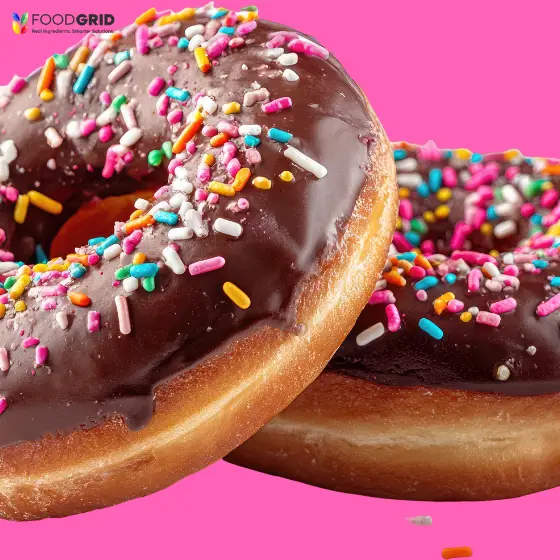
Your donut line is running at full tilt all morning. Come afternoon, your ice cream line requires the same production floor, the same labor force, and often the same topping station. Summer simply doesn’t allow for two independent processes.
This is why most manufacturers go with the difficult solution.
Operations become more complex with separate toppings for each product line, multiple application processes to manage, and valuable refrigeration and dry storage space consumed by SKUs with only marginal functional differences.
And then comes July. Volume increases, and the deficiencies start surfacing rather quickly.
But there is a far easier way. Your donut line could get its toppings from one natural sprinkles line in the morning, while the same line serves the ice cream line in the afternoon. The same raw material from the same supplier is used to produce two very different products ready for distribution.
Below is how that happens, and the things you should be considering when making the change.
Summer Puts Every SKU on the Same Clock
Summer is the busiest stretch of the year for both bakery and frozen dessert lines. The International Dairy Foods Association reports that ice cream and frozen dessert sales climb sharply from May through August, with June and July carrying the heaviest volume of the year. At the same time, donut shops and commercial bakeries push out summer flavor lines, festival orders, and back-to-school promotions.
This means your plant faces two demand peaks that land in the same weeks. If your topping supply chain cannot flex between product types, you end up choosing which line to protect and which line to slow down. Neither choice is good for a growing account list.
A single sprinkle ingredient that performs across categories removes that choice. You do not pick between donuts and ice cream. You run both.
Why One Ingredient Rarely Fits Two Product Types
Not every topping can move between a fry line and a frozen bar. Two things get in the way.
Heat. Donuts come out of hot oil or a hot oven. A topping applied before or right after frying needs to hold its color and shape under that heat. Cheap dyes fade or bleed when they hit high temperatures.
Cold and moisture. Ice cream and frozen novelties sit at temperatures far below freezing, often for weeks in distribution. A topping that works fine on a warm donut can turn soft, sticky, or dull once it sits in a freezer case that long.
Heat-stable natural sprinkles solve both problems at once. Because the color and structure hold up under high heat, the same sprinkle keeps its shape and color at freezing temperatures too. One spec sheet, one supplier qualification, and one ingredient that clears both bars.
What Natural Sprinkles Bring to a Multi-SKU Line
Natural sprinkles use plant-based food color sprinkles instead of synthetic dyes. The pigments come from sources like beet, turmeric, spirulina, and other botanical extracts. Visually, they deliver the same bright, even color that shoppers expect from a sprinkle. On the label, they let you drop the FD&C dye disclosures many buyers now flag during review.
This matters more each year. The FDA continues to review synthetic color additives, and several states have already restricted specific dyes in school and retail food programs. If your sprinkle SKU touches products sold across state lines, a clean label formula removes a compliance risk before it becomes a recall or a reformulation deadline.
For multi-SKU food manufacturing, that clean label status carries an extra benefit. You do not need one dye-compliant formula for your bakery items and a different one for your frozen items. One clean label confectionery topping covers your full catalog.
How This Plays Out on the Production Floor
Imagine an average-sized plant where there is a donut fryer in the morning, followed by switching the same finish line to soft serve and packaged novelty bars in the afternoon.
With different toppings, the plant has two receiving calendars, two storage areas, and two training programs for line operators. Any SKU change means additional set-up time and a possibility for labeling mistakes.
Using only one natural sprinkle SKU, the plant will place one order, store in one dry space, and train line operators on one way of using sprinkles. There will be the same bin for donuts in the morning and ice cream in the afternoon. This is the true bakery line efficiency that will scale through ice cream production in July.
This is the way to increase efficiency in food production. It will help you save the changeover time as fewer ingredient changes will require fewer wash cycles.
Where This Fits Across Your Product Mix
A cross-category food ingredients approach works well beyond donuts and ice cream. The same natural sprinkle line applies to:
- Frozen novelties and bars, where sprinkles need to hold color through weeks of cold storage
- Soft serve and hard scoop toppings at retail and foodservice counters
- Cake and cookie mixes that ship dry and get finished by the end customer
- Baked goods like muffins, cupcakes, and seasonal breads
- Private label retail lines that need one consistent look across a product family
If you supply foodservice distributors, this matters even more. A distributor stocking one sprinkle SKU across bakery and frozen categories cuts warehouse space and simplifies reorder points for every account they serve.
For a closer look at how natural sprinkles for ice cream manufacturing perform across shape and color range, FoodGrid’s product line covers the full spread from classic jimmies to fine natural nonpareils.
What to Ask Before You Qualify a Supplier
Moving to one cross-category sprinkle line is a supplier decision as much as a formulation decision. Before you approve any supplier for multi-SKU use, get answers on the following:
Heat and cold performance data. Ask for documented results showing color hold at your specific fry or bake temperature, and separately at your frozen storage temperature. Do not accept a general claim without numbers attached.
Batch-to-batch consistency. Natural pigments carry more natural variation than synthetic dyes. A strong supplier documents an acceptable color range per lot so your quality team knows what to expect before the product lands on your dock.
Full source disclosure. You should know exactly which plant or mineral source produces each color in the blend. This matters for your own label claims and for any certification your customers require, including organic, kosher, or allergen-free status.
Certificates of Analysis per batch. Every lot should ship with documentation covering color, particle size, and purity.
Food safety certification. Confirm SQF, BRC, or an equivalent standard, along with FDA facility registration if you distribute in the United States.
The Institute of Food Technologists publishes ongoing research on natural colorant performance across temperature ranges, which is a useful reference point when you set your own internal specs.
The Business Case, in Plain Terms
Operating two topping systems will cost you more than you think. Different SKUs mean different purchase orders, different storage requirements, and different employee training. All of these require labor hours and storage charges that aren’t itemized in a single line item cost, but they all get added up throughout an entire summer season.
Having just one natural sprinkle SKU that is able to perform equally well on both the hot donuts and the frozen bars takes care of all of that for you.
The American Bakers Association has pointed to labor and ingredient cost pressure as two of the top challenges facing commercial bakeries heading into peak production months. Cutting one redundant SKU from your supply chain is a direct, controllable response to both pressures.
Getting Ready Before Peak Season Hits
Peak volume doesn’t take time off for supplier switching. If you intend to streamline your bakery and frozen dessert toppings orders into one order, then initiate the qualification process right away rather than waiting until during your biggest production month.
Review your fry and freezer temperatures. How do these stack up to your potential supplier’s actual range of performance? Check to ensure that your certification and allergen documentation matches your customers’ needs. Try out your donut line and your ice cream bar with a smaller quantity first.
Companies that do this before their busy months reap the advantage of an entire summer’s worth of business. Those who don’t wind up in July juggling two supply chains.
Talk to FoodGrid About Your Multi-SKU Line
Our natural sprinkles are designed to work well in both bakery and frozen applications in bulk, with all documentation included from day one: COA, allergy statements, and even colorant origin.
Get a sample today or contact us for any inquiries.
Real Ingredients. Smarter Solutions.