



Consumers first notice the quality of products through their color and shape, but baking at high temperatures causes colors to fade while breaking visible components and creating uneven product textures. Snack and dessert manufacturers no longer have to choose between visual vibrancy and process reliability. The present-day manufacturing of natural colors and stable shapes includes engineering methods that create bakery-safe products that perform well in severe bakery environments without any need for trade-offs.
Vibrancy Without Compromise: Natural Colors Engineered to Perform
The baking process requires a hostile environment because it needs this particular setting to work properly. The baking process involves temperatures that range between 175 and 230 degrees Celsius (350 to 450 degrees Fahrenheit) while water levels change quickly and oxidation occurs at an increased rate. The bakery research and development teams and quality assurance experts face an ongoing scientific obstacle because they need to keep product colors stable throughout production while achieving their clean-label goals.
The baking process needed synthetic colors because they could handle high heat during baking operations. The industry has moved to natural products because government bodies, along with retail stores and buyer,s now demand these changes. The challenge is clear: natural pigments must now perform like engineered materials.
Modern natural color systems are designed with performance in mind. Through controlled extraction, concentration, and stabilization, suppliers can tailor pigments to withstand heat, pH variation, and water activity changes common in baked goods. These advances allow manufacturers to achieve consistent shades across:
- Cookies and filled biscuits
- Snack bars and inclusions
- Cakes, muffins, and brownies
- Decorative bakery toppings
At FoodGrid, our ingredient solutions are developed for real-world manufacturing conditions—not bench-top theory.
Why Color Fails in High-Heat Baking
Understanding failure modes is critical to designing successful formulations.
- Thermal Degradation
Many natural pigments—such as anthocyanins and chlorophylls—are sensitive to prolonged heat exposure. Without stabilization, they fade, brown, or shift hue during baking.
- Oxidation
High temperatures accelerate oxidative reactions, particularly in low-moisture systems. This can result in dull or uneven color distribution.
- pH Sensitivity
Bakery systems often include leavening agents that shift pH during baking. Natural colors that are not pH-buffered may change color mid-process.
- Matrix Interaction
Fats, sugars, and proteins react with pigments through distinct mechanisms as temperatures rise, leading to changes in both color intensity and shade. The process of engineered natural colors protects against these risks by using encapsulation techniques and by adjusting particle dimensions and creating tailored formulas for each system to achieve consistent results from the dough through to the final product.
The process of engineered natural colors protects against these.
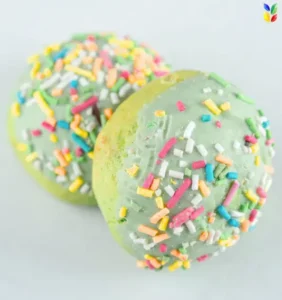
Shapes That Stay: Engineered Structural Integrity Under Heat
Color alone is not enough. Inclusions and decorative shapes must also retain form, definition, and texture after baking. Deformation, melting, or collapse can undermine product quality and increase scrap rates.
Common Structural Challenges
- Softening or spreading at bake temperatures
- Edge rounding that reduces visual definition
- Breakage during mixing or deposition
- Inconsistent distribution within the finished product
Engineered shapes are designed to address these challenges by controlling composition, density, and thermal behavior.
Material Science Meets Baking
Heat-stable shapes rely on a precise balance between:
- Melting point and glass transition temperature
- Moisture migration resistance
- Mechanical strength under shear
This engineering ensures inclusions maintain their geometry throughout mixing, baking, cooling, and packaging—delivering consistent visual impact and bite experience.
Performance Benefits for Bakery R&D and QA Teams
- Predictable Outcomes at Scale
Consistency across production runs is essential for brand integrity. Engineered colors and shapes reduce batch-to-batch variability, supporting tighter QA specifications.
- Reduced Reformulation Cycles
Ingredients designed for high-heat applications minimize trial-and-error during product development, shortening time to market.
- Cleaner Labels Without Tradeoffs
Advanced natural systems eliminate the need for artificial colors while still meeting appearance standards demanded by retailers and consumers.
- Improved Yield and Lower Waste
The ability to maintain shapes and stable colors helps reduce product rejection because of visual problems, which leads to better operational results.
FoodGrid collaborates with R&D and QA teams at manufacturing companies to develop ingredient solutions that fulfill operational requirements through their performance evaluation system. FoodGrid operates with manufacturing companies to develop ingredient solutions that match their operational needs.

Application-Specific Considerations
- Cookies and Biscuits
Low moisture and extended bake times demand pigments with high oxidative stability and inclusions with controlled spread resistance.
- Snack Bars and Baked Snacks
Matrix density and post-bake handling require shapes that withstand compression and cutting without fracture.
- Cakes and Muffins
Rapid temperature rise and pH shifts make buffered color systems essential for shade consistency.
- Decorative Toppings
Surface exposure increases thermal stress, making encapsulated color systems and reinforced shapes critical.
Selecting the right ingredient system is application-specific—and should be validated under actual production conditions.
Regulatory and Quality Alignment
Natural color and inclusion systems must comply with global food safety and labeling regulations. Reputable guidance includes:
- U.S. Food & Drug Administration (FDA): https://www.fda.gov/food
- Institute of Food Technologists (IFT): https://www.ift.org/
- USDA Food Safety and Inspection Service: https://www.usda.gov/
- European Food Safety Authority (EFSA): https://www.efsa.europa.eu/
Staying aligned with these standards ensures both compliance and market access.
The Future of High-Heat Bakery Design
As bakery products evolve, expectations for visual appeal will only increase. Ingredient systems must continue to integrate food science, material engineering, and process understanding.
Future innovations will focus on:
- Broader color palettes from natural sources
- Enhanced heat tolerance without encapsulation tradeoffs
- Shapes engineered for automated, high-speed production lines
Manufacturers who invest in performance-driven ingredients today will be best positioned to lead tomorrow’s bakery aisle.
Our B2B-focused ingredient solutions are engineered for performance, scalability, and clean-label success. We offer B2B ingredient solutions that deliver outstanding operational results and scalability, and clean-label compliance. Talk to our specialist or request a sample.