


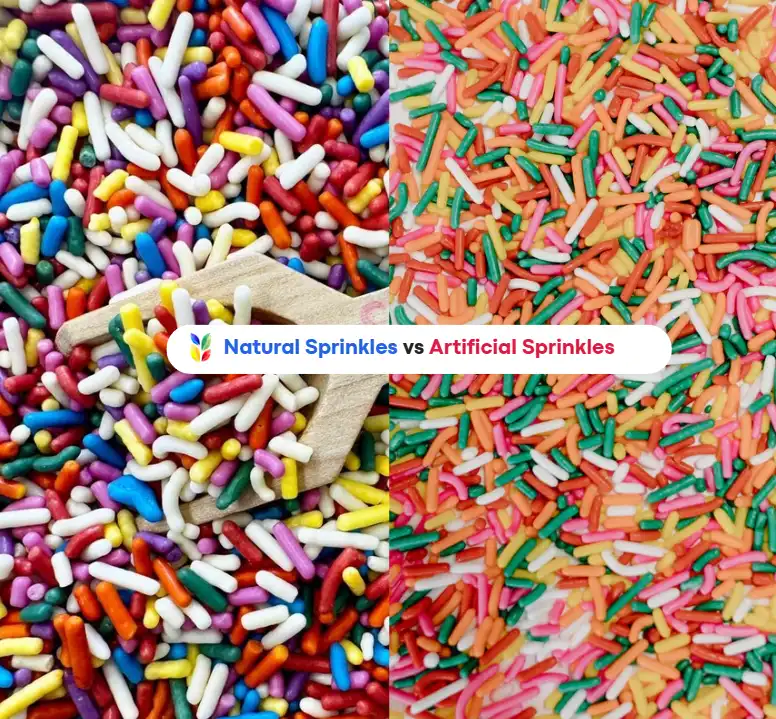
The move towards natural products is not a future trend but rather something that is currently taking place. As such, for R&D specialists, brand owners, and food developers, sprinkles are the key to this transition.
The Turning Point for Decorative Ingredients
For years, artificial sprinkles dominated the market—offering bright, uniform colors at low cost. But today, that model is under pressure from every direction:
- Increasing regulatory scrutiny on synthetic dyes
- Retailer and private label clean-label requirements
- Consumer demand for transparency and recognizable ingredients
For product developers, this creates a clear challenge:
How do you maintain visual appeal while meeting clean-label expectations—without compromising performance?
Why the Shift to Natural Is Accelerating
Natural sprinkles have stopped being the odd ones out, but have become the new norm in product development.
The use of natural colorants such as beet, spirulina, and turmeric is helping brands produce trending colors that meet the clean label guidelines.
However, the move isn’t just a question of consumer perception, but also of product longevity.
Brands that continue to rely on artificial colors risk:
- Reformulation pressure
- Retailer delisting
- Reduced consumer trust
Meanwhile, brands adopting natural inclusions gain:
- Stronger label appeal
- Easier global compliance
- Competitive differentiation
The R&D Challenge: Performance vs. Clean Label
Historically, natural sprinkles came with trade-offs:
- Color instability during baking
- Fading under light or storage conditions
- Limited shade consistency
That is why most R&D groups were reluctant to move into such a process.
Times have changed.
In FoodGrid Inc, clean-label sprinkles are designed with the end goal in mind, not just their ingredients. This gives developers the flexibility to achieve functionality without sacrificing formulation integrity.
What Modern Natural Sprinkles Deliver
FoodGrid’s clean-label sprinkles are built to meet the demands of large-scale manufacturing:
- Color Stability Across Applications
Formulations are designed to maintain vibrancy through:
- Baking
- Freezing
- Ambient and extended shelf life
- No Artificial Dyes or Titanium Dioxide
Products are free from synthetic additives, supporting:
- Clean-label positioning
- Regulatory alignment across global markets
- Allergen-Free and Non-GMO
Simplifies formulation and reduces complexity for:
- Multi-SKU production
- Cross-contamination risk management
- Consistent Particle Size and Flow
Engineered for:
- Even distribution
- Reduced dusting
- Smooth processing at scale
- Scalable Performance
Designed to run efficiently in high-volume environments—supporting:
- Yield optimization
- Reduced downtime
- Repeatable output
These capabilities reflect FoodGrid’s focus on production-ready inclusions, not just ingredient substitution.

Innovation Through Color
Color is one of the first things consumers notice—and one of the fastest ways to communicate product quality.
Natural sprinkles unlock new possibilities for:
- Trend-driven color palettes (pastels, botanical tones, seasonal blends)
- Premium product positioning
- Clean-label storytelling
For developers, this means color is no longer a limitation—it’s a strategic advantage.
What This Means for R&D and Brand Teams
The transition to natural sprinkles is not just a formulation update—it’s a strategic shift in product development.
R&D teams must now consider:
- Ingredient transparency from the start
- Functional performance under real processing conditions
- Scalability across production lines
Brand owners must evaluate:
- Label positioning and consumer perception
- Retail and regulatory alignment
- Long-term portfolio sustainability
The companies that move early will define the next generation of bakery and snack innovation.
Final Takeaway
Artificial sprinkles created the category. Natural sprinkles are reinventing it.
Thanks to advances in technology and science, trade-offs are no longer necessary. All that’s left is to embrace the chance to have everything come together in one ingredient system. To R&D groups, brands, and food formulators, we say:
The shift is not coming. The shift has arrived.
Looking to make the switch without sacrificing performance? Reach out to our expert now for more information, samples, and more.