



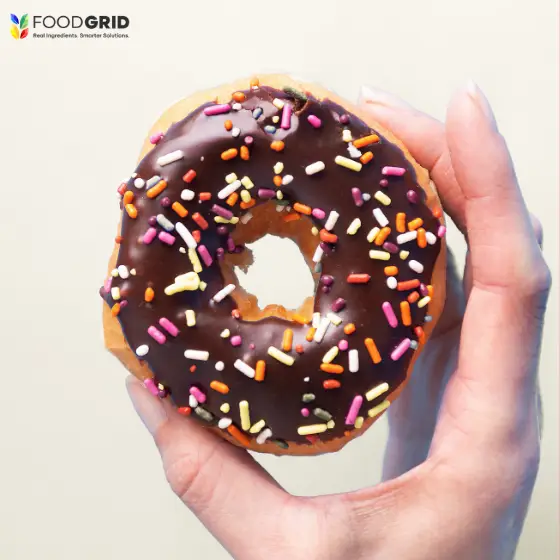
Halloween decoration runs on orange, purple, and red. Those three colors have always depended on Red 40, Yellow 6, and Blue 1, the same artificial dyes that the FDA is phasing out and that Walmart, Target, and other major retailers are already removing from their private-label lines.
FoodGrid carries natural colored sprinkles in all three Halloween colors. Orange uses annatto extract. Purple uses vegetable juice. Red uses vegetable juice, annatto extract, and paprika oleoresin. All three are NON-GMO Project Verified, soy-free, nut-free, dairy-free, and gluten-free.
The sourcing question is not whether natural works. It is whether your R&D, procurement, and brand teams know what each color delivers at commercial scale, what heat and process considerations apply to your production setup, and how to lock in your order before your October production window closes.
This post gives your team the practical sourcing guide it needs right now.
Why This Is a September Decision, Not an October One
Halloween product development deadlines move earlier every year. Retail buyers plan October seasonal sets in Q2. Production windows for decorated bakery products tied to a late September or early October shelf date typically close in July and August. If you are reading this in September, you are already in the narrow window.
You need a qualified natural dye sprinkles supplier, a confirmed spec, and a production-ready order placed before your line schedule closes for October output.
If you are planning for next year, this post gives you the full picture so your team enters Q4 planning already knowing which FoodGrid natural colorant sources cover your Halloween palette, what to test, and what documentation to require before you commit.
The FDA’s color additive updates in 2025 and 2026 expanded the approved toolkit for natural food colors. The natural palette for commercial food manufacturing is broader now than it was eighteen months ago. The sourcing question for your Halloween program is not whether natural options exist. It is which options are available, documented, and production-ready before your window closes.
Orange: The Anchor Color of the Halloween Palette
Orange is the highest-demand color in the Halloween seasonal set. It is also one of the most straightforward natural dye sprinkle conversions available because the colorant source performs reliably at commercial baking conditions.
FoodGrid’s Natural Orange Sprinkles use annatto extract as the colorant. Annatto comes from the seeds of the achiote tree and produces a warm, rich orange tone. It is FDA-approved as an exempt color additive and carries a clean, recognizable declaration on your ingredient list. No petroleum. No FD&C certification number. Just annatto extract.
At standard commercial baking temperatures between 325 and 375 degrees Fahrenheit, annatto-based orange holds its color through the bake cycle and through the full retail distribution window when stored correctly. Your R&D team should confirm performance at your exact oven temperature and bake cycle length, but for most cookie, donut, ice cream topping, and confectionery applications, the orange performs without a process change from your current synthetic sprinkle setup.
Coverage rate matters. At three to five grams per unit, the orange delivers the visual saturation your Halloween brief requires. Test at your actual commercial application weight before you finalize the spec, not at a bench trial rate.
FoodGrid’s Natural Individual Colored Sprinkles include natural orange in 10 lb, 25 lb, and 50 lb packaging formats for commercial bakery programs.
Purple: The Tone That Defines the October Visual
Purple is the second core Halloween color, and the one most teams focus on when moving away from Blue 1 and Red 40 combinations. A dull or muted purple reads as off-palette. A saturated, deep purple reads as intentional and seasonal.
FoodGrid’s Natural Purple Sprinkles use vegetable juice as the colorant source. The result is a full, rich purple that delivers strong visual impact at commercial coverage rates. The vegetable juice base performs across the decorated bakery applications FoodGrid’s line is built for: cookies, donuts, ice cream toppings, and general confectionery decoration.
For R&D teams evaluating natural purple at commercial scale, the key process consideration is application method. Natural purple pigments from vegetable juice sources perform well in post-bake decoration and no-bake applications. For oven-applied decoration at higher temperatures, test at your specific bake conditions before locking in the spec. Post-bake application, where the sprinkle is applied after baking using a glaze or egg wash as a bonding agent, is the lowest-risk process for preserving color vibrancy in high-temperature baking operations.
For foodservice and retail programs where the decorated product is applied cold or at ambient temperature, no process change is needed. The purple performs as specified.
Food Research Lab’s natural color trend analysis documents that deep purples from natural sources are gaining traction in commercial confectionery applications as synthetic dye options phase out. Demand for natural purple is rising faster than many supply chains have scaled to meet it. Confirm your order and lead time early.
Red: The Third Pillar of the Halloween Color Set
Red completes the Halloween spectrum and serves a dual purpose in the October holiday range. It balances orange and purple in the Halloween set, and it carries forward into November for programs that move Halloween-decorated SKUs into autumn harvest and Thanksgiving without a full redesign.
FoodGrid’s Natural Red Sprinkles use a blend of vegetable juice, annatto extract, and paprika oleoresin. That combination produces a deep, rich red at commercial color levels. All three colorant sources are FDA exempt colors with clean label declarations, which is what retail buyers check when reviewing private label Halloween product submissions.
Paprika oleoresin contributes heat stability to the red formulation. For R&D teams concerned about oven-applied natural red sprinkles, the paprika component helps the color hold through standard baking conditions better than single-source beet or vegetable juice reds. That makes FoodGrid’s natural red a stronger performer for cookie and donut programs that apply sprinkles before baking rather than after.
For operations teams managing a seasonal product calendar that carries from October into November, natural red also covers the warm, harvest-adjacent tone that works in Thanksgiving-decorated programs without requiring a separate sourcing event. One color, two seasons. That is a real sourcing efficiency at commercial scale.
Northwestern Extract’s natural food coloring guide notes that the natural colorant toolkit available to manufacturers has expanded significantly with recent FDA approvals, and that the best choice for any application is the one that fits the specific product system rather than a general benchmark. FoodGrid’s natural red formula is built for the bakery and confectionery applications where you need it most.
The Halloween Blend: One SKU for the Full October Palette
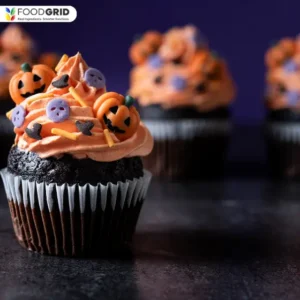
For brand managers and procurement teams who want the full Halloween visual in a single-sourced item, FoodGrid’s Natural Seasonal Blends include a Halloween Blend that combines the full seasonal palette into one ready-to-use product.
The Halloween Blend removes the need to qualify orange, purple, and red components separately. One SKU. One qualification file. One lead time. Your brand team gets the complete Halloween look. Your procurement team qualifies one item. Your QA team receives one COA.
For private label programs with tight development schedules, the Halloween Blend is the fastest path from brief to decorated product in production. For teams managing multiple seasonal SKUs in a compressed Q4 calendar, sourcing the Halloween Blend from the same supplier handling your Thanksgiving and Christmas programs reduces supplier management overhead.
FoodGrid’s Natural Seasonal Blends also include Valentine’s Day, Fourth of July, Thanksgiving, Christmas, and sports team blends, all from the same supplier base and under the same qualification.
The Retail Buyer Compliance Picture for Halloween Natural Sprinkles
For brand managers submitting a Halloween seasonal SKU to retail accounts, the compliance picture is clear.
Walmart’s private label reformulation commitment covers baked goods, frosting, and decorated items as part of its commitment to remove artificial colors from private brand food products. Target moved to dye-free programs before federal deadlines. Both decisions apply directly to decorated bakery items that use FD&C colors in the sprinkle component.
A Halloween cookie, donut, or cupcake submitted to either of these retail accounts with Red 40 in the orange and Blue 1 plus Red 40 in the purple will not pass their current program requirements. This is not a future consideration. It is today’s qualification standard.
Non-GMO sprinkles and nontoxic sprinkles are not premium tier features for these retail programs. They are the floor. FoodGrid’s full natural sprinkle line carries NON-GMO Project Verification, which satisfies the non-GMO documentation requirement for retail supplier audits without a separate certification step.
For procurement managers finalizing supplier qualifications for fall seasonal programs, FoodGrid delivers COA per lot, colorant source disclosure, allergen statement at product and facility level, and non-GMO verification at onboarding. No document chasing after your order is placed.
Process and Application Checklist for R&D Teams
Before you approve a natural Halloween sprinkle spec for production, your R&D team needs to confirm five things.
- Application method: oven or post-bake. Red and orange perform well in either method under standard baking conditions. Purple performs best in post-bake and no-bake decorating. Match your application method to each color’s stability.
- Coverage rate at your commercial application weight. Test at three to five grams per unit as your baseline. Adjust based on your visual specification and substrate color. A white icing base shows natural color differently than a chocolate frosting base.
- Substrate confirmation. Test your natural sprinkle palette on your actual product surface, not a neutral lab substrate. The interaction between your dough, icing, or glaze base and the natural colorant determines the finished visual your customer sees.
- Shelf life through your distribution window. Natural pigments can be sensitive to light and oxygen. Confirm color stability through your full retail distribution and sell-through period, not just at the point of production.
- Lead time against your production schedule. Natural sprinkle supply chains tighten in Q3 and Q4. Confirm your supplier’s production and delivery lead time against your line schedule before you place the order.
FoodGrid’s Non-GMO Natural Sprinkles are available in 10 lb, 25 lb, and 50 lb formats for commercial bakery programs, with full documentation delivered at onboarding before your first order ships.
All-Natural Sprinkles for Your October Program. One Supplier.
FoodGrid carries orange, purple, and red natural sprinkles for your Halloween product line. Use them individually or order the Halloween Blend from FoodGrid’s Natural Seasonal Blends. All products are NON-GMO Project Verified, soy-free, nut-free, dairy-free, gluten-free, free from artificial preservatives, and colored only with natural coloring agents.
For operations directors managing a compressed Q4 sourcing calendar, FoodGrid also carries Natural Sprinkle Shapes in natural colors for programs that need seasonal visual differentiation beyond standard jimmies and rounds, all under the same supplier qualification.
You do not need three suppliers for your October palette. You need one that carries the colors, holds the documentation standard, and confirms the lead time before your production window closes.
Contact our ingredient team or request samples and documentation at foodgridinc.com.
Real Ingredients. Smarter Solutions.


